


As you are reading this, somewhere in the world a computer just wrote a song. Not only that, but if you heard it on Spotify, it’s doubtful that you would be able to tell it was generated by Artificial Intelligence (AI). As AI slowly creeps into every aspect of today’s modern world, it is still almost shocking that it has managed to find its way into a field entirely built on human creativity. And yet, we live in a world where AI is writing songs, and your next favorite love song might just be written by a computer that has never been in love.
Songwriters spend years carefully crafting songs based on their own life experiences, and there is now the potential for a viral song to have been created at the click of a button.
AI is not only writing these songs, but there are now AI artists with fake names and voices singing them. According to Billboard, at least six AI or AI-assisted artists have debuted on various Billboard rankings in the past few months.
A well-known example of this is the song “I Run,” released in late October, which amassed over 13 million listens on Spotify and climbed to number 11 on Spotify’s US charts. The song was removed from major streaming platforms after being exposed for using AI-generated vocals.
When this song was first released, it went viral across social media for being trendy and catchy, yet for weeks, many were unaware of the fact that the voice they were hearing everywhere was not human.
While some argue that AI is leading us into a new, better age of music, this idea contradicts the reality that these songs lack originality. AI’s data is programmed to use information that comes entirely from the past, limiting creativity and having no new ideas, but rather copying what people have written in the past. You can’t argue that the potential for great-songwriting outweighs the ethical concerns if these AI-generated songs lack the innovation or originality needed to justify them.
This debate also rehashes opinions similar to those from when autotune came out in the 2000s. At the time, people were questioning the ethicality of autotune and whether it was just a way for artists to mask their otherwise unpleasant voices. But this is different. With autotune, it is clear when it is present, and the ideas are still original. The same cannot be said for AI.
A recent survey conducted by Ipsos for French music streaming service Deezer reported that 97% of people polled couldn’t tell whether a song was created by AI.
While it is certainly problematic that AI has begun to sound more and more human-like, potentially replacing jobs of singers and songwriters, another major concern related to this is the possibility of real human artists beginning to sound more like AI. This would not only create little to no differentiation between artists, but it would also send the music industry into a downward spiral.
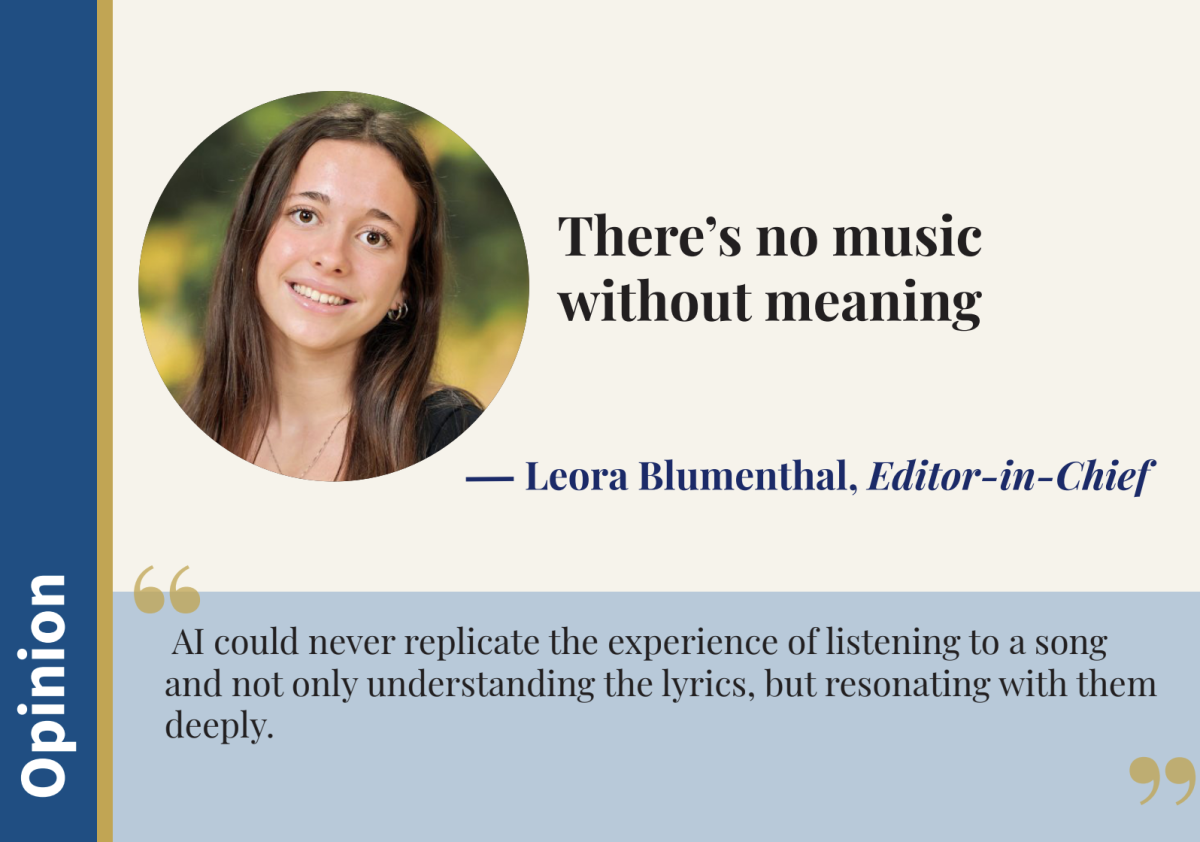
If AI takes over, it will eliminate a core value of music: authenticity. AI could never replicate the experience of listening to a song and not only understanding the lyrics, but resonating with them deeply.
Creativity takes work. ChatGPT could create a song in moments with no effort, but the output would have no meaning.
A real artist writes from the heart and creates music that people can relate to on a personal level. If the music industry continues down this path, it risks replacing one of the most human forms of expression with something entirely artificial. Music has always been about storytelling and emotion, things no machine can truly understand. If we allow computers to take over the creation of music, authenticity will disappear, and it will be impossible to get back.


Eve Sharp • Mar 20, 2026 at 12:58 pm
I had never heard of this before reading this article – what a fascinating topic, Leora! Amazing EIC over here!