
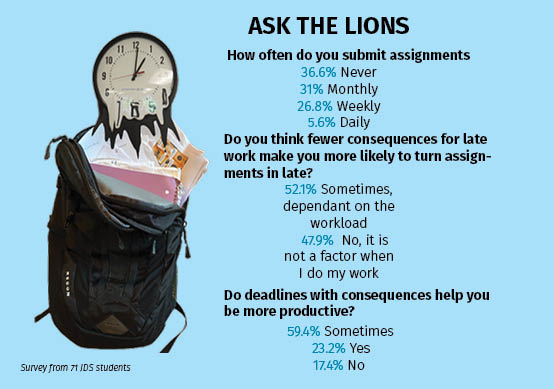
“I’ll just do it later,” is one of the most common phrases heard in the JDS hallways. Sometimes it applies to studying for a test, sometimes to finishing a problem set and sometimes to an assignment due yesterday. In a school where most deadlines don’t carry strict consequences, this phrase has become a frequent state of mind for many students, rather than an occasional flexibility.
During the 2023-2024 school year, the JDS high school adopted a new grading system, and alongside it came a new late-work policy. The policy is simple: no grade deductions for late work if an initial deadline is missed. Students sometimes will not be able to retake late assignments and their grade could drop to a 50% at a later date. When assignments pile up, the goal is that students can take advantage of the policy and occasionally submit an assignment a couple of days late.
However, the policy did not result in better time-management or organizational skills; students don’t have to organize their time because they know that if they miss a deadline, nothing immediately consequential will happen. This leads to even more missed deadlines. A study from the University of Tennessee found that people take twice as long to finish a task after missing an initial deadline.
The previous late penalty policy, which held a 10% grade reduction each late day, was punitive and not really enforced, according to High School Principal and Upper Campus Head Lisa Vardi. This led to a rethinking of how late work should be dealt with. While it is necessary to have a standardized policy across the board, the transition to no real enforced late penalties did not truly help solve the problem of personalized penalties.
This imbalance also creates an unfair dynamic where students who submit work late are rewarded, as they have more time to improve their work than those who complete assignments on time. For assignments given in a short period of time, a “good” student will make time in their busy schedule to complete the work promptly, even if it means sacrificing some quality. However, a “smart” student will put the assignment off, knowing there will be no immediate consequence.
The next day in class, as the curriculum moves forward, many students drag behind as they have not fully completed the previous material. This diminishes the quality of classroom discussion and places additional stress on teachers, who must teach a class at different stages of the curriculum. When assignments are submitted late, teachers often cannot return graded assignments until everyone has completed their work. This becomes unfair for both students and teachers.
If, from the ages of 14-18, deadlines are effectively meaningless, students will not learn to plan their time in advance or respect others’ time. In college and the real world deadlines are often strict and punitive. Missing them can mean reduced grades or professional consequences. With real late penalties, students will learn the skills and necessity of punctuality.
The lack of respect for deadlines taught at JDS can seep into other aspects of life: if deadlines are not required for schoolwork, why should someone prepare for their interview on time?
The late policy was created to benefit students. However, nearly three years later, it is clear that it should be adjusted to better serve both students and teachers. This does not mean eliminating flexibility entirely. We advocate implementing extensions requested ahead of time alongside a strict late-work penalty. Extensions approved in advance by teachers offer a more structured and responsible approach to the issue.
We don’t necessarily have to return to the former model, where each teacher enforced late-work penalties to their own extent. However, having a clear and standardized model across the board with immediate consequences will help create a better classroom environment.
Late work is inevitable in any high school. But it should be discouraged, not embraced. Students should learn to manage their time responsibly, and teachers should not have to slow down or consistently deal with late submissions. With a stricter policy, the school can better prepare its students for managing their workload in the future.