

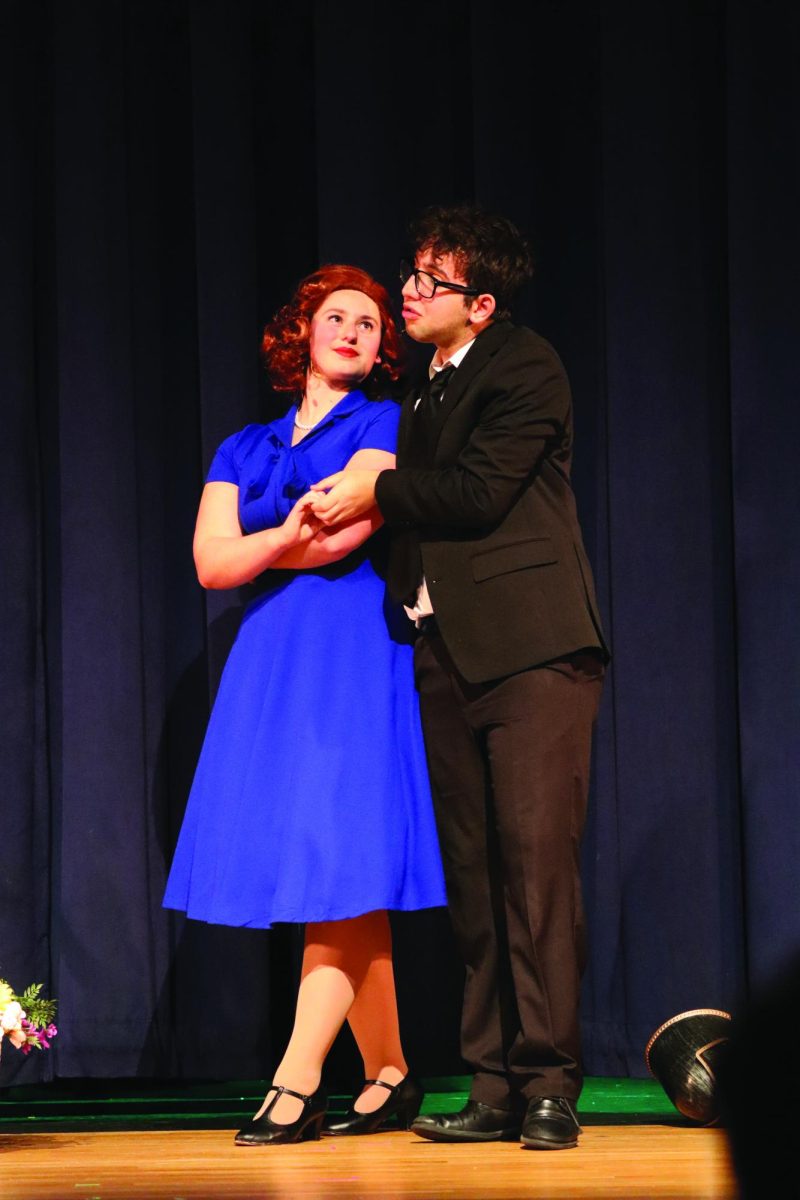
Junior Claire Elbaum straightens up and tosses her hair back to prepare for her scene in the JDS spring play, “The Importance of Being Earnest.” Sporting cat eye glasses and a purse, she is ready to embrace her conceited character, Lady Bracknell, the antagonist of the production.
The play, written by Oscar Wilde in 1895, is a comedy mocking social conventions and marriage. JDS’ production was performed on April 29 at 7:00 p.m., and was also shown to the entire high school during the school day for the first time since JDS began producing a high school spring play.
“I really think [the play is] just a very funny satire of the way that people behave when there are goals in society,” English teacher and director Nancy Wassner said.
Wassner has been directing the spring play for three years, and switches off between one year of Shakespeare and two years of plays by other authors. This year, the play followed the story of two men, Jack Worthing and Algernon Montcrieff, who take on false identities of a man named “Earnest” to escape their responsibilities and attract the attention of their intended lovers. Sophomore Noah Terl plays Algernon and feels very connected to his character.
“He loves to eat, he’s very careless and expressive,” Terl said. “I kind of just play myself for a lot of it. It’s very convenient.”
Terl’s experience in the school musical and performances at Bucks Camp motivated him to try out for the play. Terl particularly enjoyed the first act, where he comically devours many cucumber sandwiches to annoy his friend Jack after h aving been asked to share.
Compared to past productions he has been in at camp, Terl appreciated how much time the cast was given to develop their characters beyond memorizing lines and blocking.
“I felt it was really open to make your own creative decisions for your characters,” Terl said. “The moment where I kind of got to decide how [my character] walks, how does he talk, how does he say this line.”
To bring their characters and scenes alive, the show’s set and costumes were carefully procured at school and at the actors’ homes. Wassner instructed her cast to bring clothes from home that could function as costumes for their characters, and ensured any new costumes purchased could be used in future productions. The set was simple yet functional, featuring a donated coffee table, a couch, chairs and a picnic blanket.
The cast began rehearsing three days a week in January, and switched to four days with longer rehearsals as the show grew nearer. At the beginning of the rehearsal process, actors were focused on memorizing lines and determining proper blocking. After the cast completely memorized their lines, the focus turned to refinements on specific scenes and full run-throughs.
One challenge the play faced was the frequent snow days and breaks dispersed across their preparation time. To ensure actors stayed on top of their roles, Wassner emphasized the importance of practicing through lines over spring break so that rehearsals could run as smoothly as possible when students returned.
Elbaum is well acquainted with this process and has been participating in the play since her freshman year. This year, although the play is set in 1950s America, the dialogue still included older 19th century English. For Elbaum, part of the reason she finds this play especially humorous is because of this unique language style.
“When it comes to the actual performance, actually hearing the audience laugh at all these jokes that you forgot were funny is so exciting because it makes you feel like you did something that made somebody laugh and made someone smile,” Elbaum said. “That’s what it’s all about, really.”