
Roald Dahl has consistently been a controversial author, with people often struggling to reconcile the duality of his character. He wrote stories that empowered children and embraced the imaginative side of life, but he was also a deeply bigoted person who made abhorrently antisemitic generalizations about Jews.
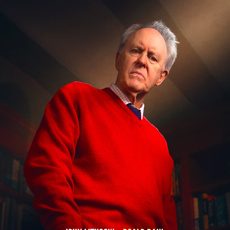
“Giant,” a play I saw on Broadway over spring break, starring John Lithgow as Roald Dahl and directed by Mark Rosenblatt, reckons with this polarity and the dark side of Dahl’s character quite effectively in a way that is strikingly applicable to modern-day debates over the Israeli-Palestinian conflict.
Set in the summer of 1983 in the home of the writer, the show opens with already accomplished author Dahl, newly married to his mistress Liccy, nearing the publication of his book “The Witches.” This publication, however, is overshadowed by a book review he wrote about “God Cried” that condemned Israel’s invasion of Lebanon and made troubling antisemitic generalizations about Jews, saying “Never before in the history of man has a race of people switched so rapidly from being much-pitied victims to barbarous murderers.”
Whether his comments were simply an overstep, as he defends, or if they were a symbol of overt antisemitism is the subject of the play. In the play, his publishing company sends a fictitious young marketing executive, Jessie Stone, played by Aya Cash, along with the writer’s literary agent, Tom Maschler, played by Elliot Levey, to persuade him to issue a statement apologizing for his comments.
The rest of the play is set in a single back-and-forth conversation between Maschler and Stone, both of whom are Jewish, and Dahl. In response to their demands of an apology, Dahl goes from passionate but controlled to simply cruel. Stone, initially indifferent to the writer that she and her son love, eventually becomes equally as passionate in her defense of Judaism, arguing for the distinction between Jews and Israel and demanding an apology to all Jews.
What struck me about “Giant” was how closely it aligned with the antisemitism seen across the world today and how the play wasn’t simply a biography, but a character study of ego, prejudice and the need to provoke. It captures Dahl’s wit, charm and real concern for people struggling in Lebanon, while simultaneously making his stubbornness and cruelty impossible to ignore, all done by using real quotes he said throughout his career.
Lithgow is central to that success as his performance didn’t make me flatten Dahl into a single-faced villain. He presents Dahl as layered, funny, charismatic and likable in instances, demonstrating how prejudice can live inside people who display amiable qualities, convinced of their own moral clarity. That contradiction is captured with precision.
At a time when debates over Israel’s actions and antisemitism remain highly charged, “Giant” stands as a warning of how quickly criticism of a government’s actions can derail into ethnic hatred and how pride and stubbornness can prevent a person from recognizing the damage of their actions. Most of Dahl’s arguments felt chillingly familiar to what is being echoed around the world, that “there is a trait in the Jewish character that does provoke animosity” and arguments for the “puppetmaster” trope, which persists today in conspiracy theories regarding Zionist control of Western governments.
That warning reaches a climax when Lithgow, perhaps in the most unsettling part of the play, repeats Dahl’s notorious line from his 1983 “New Statesman” interview, suggesting that antisemitism is a logical response to Jewish behavior: “There’s always a reason why anti-anything crops up anywhere; even a stinker like Hitler didn’t just pick on them for no reason.”
In the end, for me, “Giant” acted as a mirror held up to the present. The play forced me to examine how prejudice is rationalized, repeated and excused, especially when it comes from admired figures wrapped in charisma and the facade of moral superiority. What the play achieves is forcing the audience to wrestle with the powerful question of how willing we are to confront hatred when it comes from voices we cherish.