
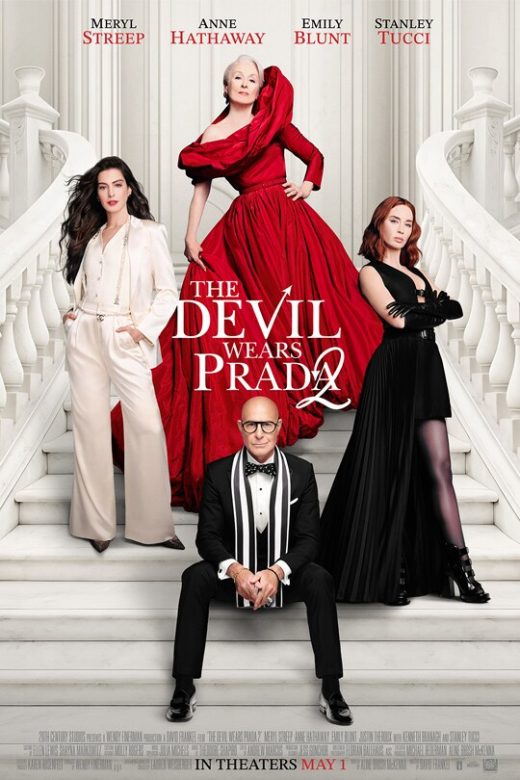
Nearly 20 years after The Devil Wears Prada made audiences fall in love with the glamorous chaos of fashion media, its sequel swaps escapist charm for watered-down social commentary.
The original film follows Andy Sachs (played by Anne Hathaway), a young journalist who lands a job as a junior assistant to Miranda Priestly (played by Meryl Streep), the demanding, cruel editor-in-chief of Runway, a top fashion magazine.
What I, like many others, loved about the original was how otherworldly it felt. “The Devil Wears Prada” transported the viewer into a world of Chanel, Dolce and Gabbana, private cars and hot cappuccinos. Every challenge felt manageable, every insult delivered with precision. The movie invited us into a world of stylish escapism.
“The Devil Wears Prada 2,” however, does not return us to that same universe.
The second film follows Sachs 20 years later, when she returns to a Runway, which is now battling cancel-culture, corporate restructuring and the general chaos of modern media survival. Together, Andy and Miranda attempt to save the magazine from being dismantled by Wall Street interests.
In theory, the film tries to tackle major contemporary issues such as the decline of journalism, the rise of AI and the consolidation of media power. In practice, a fashion comedy isn’t really equipped to handle those major issues, at least not in a nuanced way. Instead, it threw in the occasional political hitline, nodding to the viewers that in these politically fragile times, “The Devil Wears Prada 2” really does care.
The movie embraces itself as a sequel to a cult classic and recreates many famous scenes and lines, including the infamous moment with Miranda sitting behind a desk, oppressively criticizing everyone else’s work.
One modernized bit that did work in the movie was Miranda being censored by the magazine’s human resources. It recognizes that her bad boss habits wouldn’t go over as smoothly in the modern workplace and turns it into a playful critique of corporate culture.
The cast of the movie was filled with celebrity cameos, from Lady Gaga to Donatella Versace. These appearances help build a glossy high fashion world of extravagant dinners, luxury hotels and skyline views.
Emily Blunt and Stanley Tucci return as Emily and Nigel, slipping back into their roles with ease. As always, Streep delivers a hilariously precise Miranda, delivering lines in an iconic tone only Streep can procure. However, the writing attempts to humanize Miranda, giving nuance that the character didn’t really need. “The Devil Wears Prada” is meant to feel mythical, the characters don’t have to be human.
Sachs continues to serve as the loving protagonist of the story. However, her original boyfriend does not return in the sequel. Instead, she is given a half-hearted love interest who appears only when the script needs a motivational speech or a brief flirtatious exchange, before disappearing again. The result feels underdeveloped and forced. But then again, what is a female protagonist without her handsome love interest?
“The Devil Wears Prada 2” embraces its identity as a sequel. It delivers amazing callbacks, familiar characters and great acting. However, it lacked the charm of the original, and its attempts at social commentary felt unfit. The movie is great for any diehard “The Devil Wears Prada” fans, but anyone else is perfect with just watching the first one. And yes, I admit this is a rather harsh critique, but that is what Miranda would’ve wanted.