
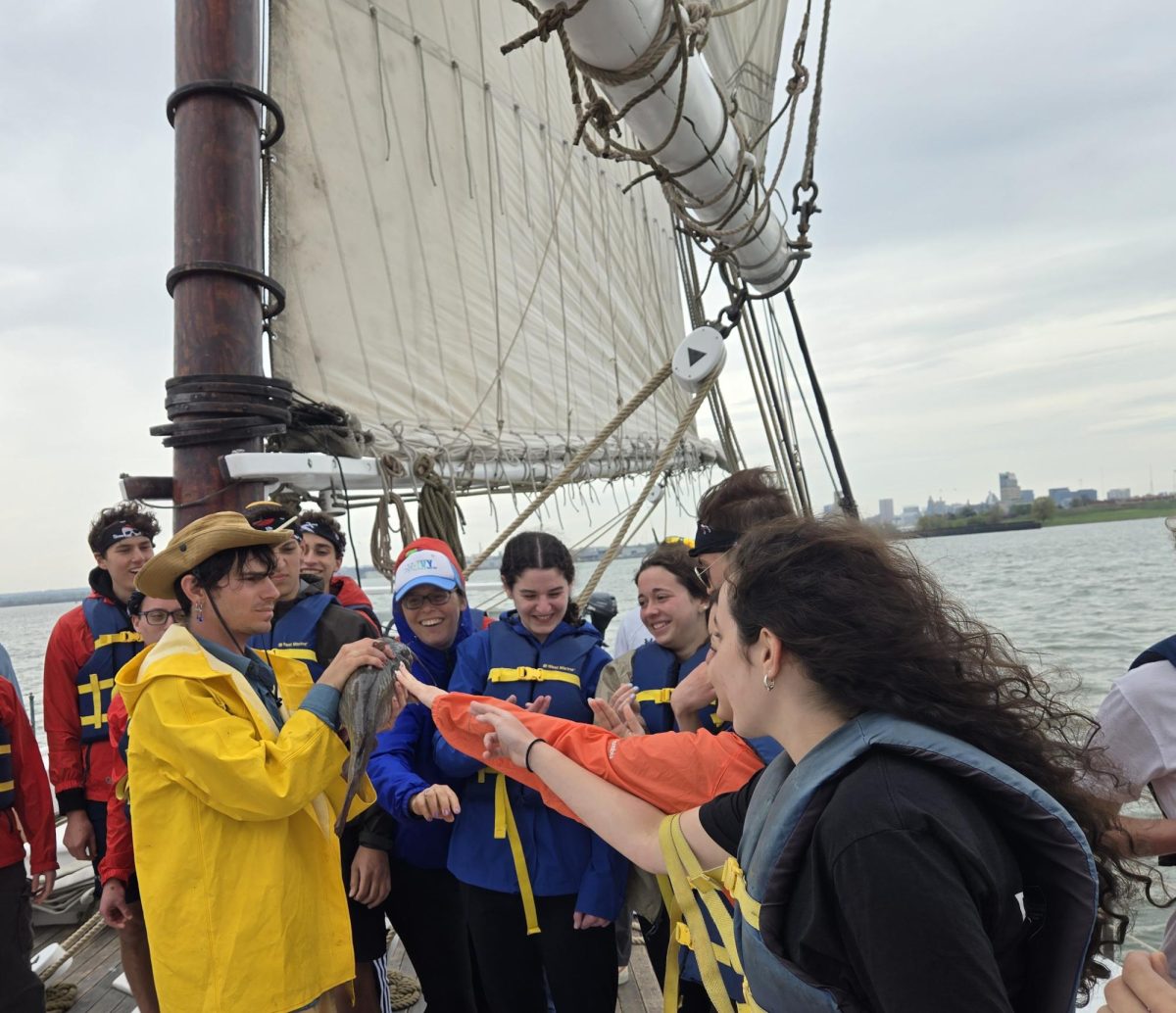
On the first day back from spring break on April 14, instead of getting back into the steady rhythm of classes, high school students in JDS’ STEM Fellows program attended a field trip to Baltimore’s Inner Harbor to learn about marine biology, environmental science, ship navigation and the Chesapeake Bay. The experience, run by the Baltimore-based educational company Living Classrooms, included hands-on activities such as raising a sailboat’s masts and using a large net to fish.
The STEM Fellows program was started in 2020. Fellows help run STEM activities for students of all grade levels, including the Sunday STEM series for Lower and Middle school students and the annual High School STEM conference. There are currently 20 students in the program.
According to Director of Upper School STEM Alexandra Brown, who also serves as the adviser for the STEM Fellows, the goal of these field trips is to allow the Fellows to work on team building while expanding their knowledge of STEM outside the classroom. Many Fellows thought that this field trip accomplished this goal.
“I enjoy getting to see how STEM is used outside of school, because sometimes in school, STEM classes can feel somewhat theoretical and hard to understand how the concepts are actually used in the real world,” freshman and STEM Fellow Rayut Weiser-Rosenbaum said. “Being a STEM Fellow allows me to see how different ideas of STEM are applied in the real world.”
On the trip, the STEM Fellows boarded the Lady Maryland, a replica sailboat of a pungy schooner, a type of long four-sailed boat commonly used in the Chesapeake Bay area in the 1800s. They worked with the deckhands of the boat to raise the large sails as the boat moved into Baltimore’s harbor.
After a lunch break, the trip’s focus moved to marine biology. Fellows used a trawl net, a large net thrown off the boat and dragged on the ocean floor, to catch some fish in the harbor. They then used dichotomous keys to identify the species of fish they caught before safely releasing them back into the water. Finally, they participated in an activity where they learned about how long it takes for different trash items, such as plastic bottles or aluminum cans like those found in the net, to biodegrade at the bottom of the ocean.
“It was cool looking at the fish that we got from the bay… there’s just a wide variety of different types of fish that we got,” junior and STEM Fellow Adin Kahan said. “[It] was also cool to see their natural camouflage.”
This field trip is one of two mandatory annual STEM Fellows field trips. Earlier this school year, the Fellows went to the National Aquarium in Baltimore, where they dissected squid. Trips from previous years have included going to I-FLY Indoor Skydiving to learn about terminal velocity and visiting the Smithsonian Environmental Research Center.
In looking for places to take the fellows on field trips, Brown said that she wants to find a unique and memorable experience for them.
“I’m looking for something that has some kind of hands-on component,” Brown said. “I’m looking for something that students wouldn’t necessarily have access to on their own without being part of a school group.”
By the end, many Fellows felt that the trip was a worthwhile experience that gave them an opportunity to learn new things outside of a school setting.
“I think it’s a lot more memorable when you’re actually seeing how [STEM] applies in the real world,” Weiser-Rosenbaum said. “And it’s also really fun being out on the water…[getting] a change of scenery, a change of pace. You’re not just sitting at a desk taking notes; you can actually touch the fish that you’re learning about.”