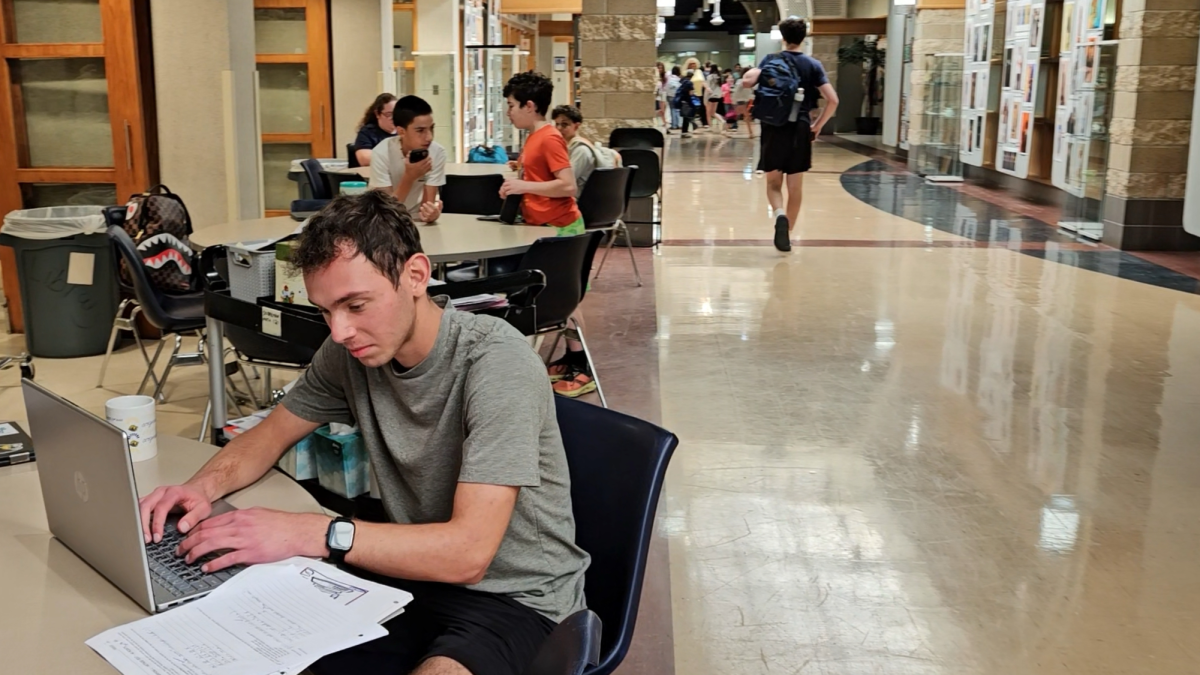


The moment a teacher says “Open up your laptops,” they’ve already lost the room.
It’s not the teacher’s fault. How can they compete? Computers have more information than the Library of Alexandria, and that isn’t including video games, text messages and every YouTube video ever uploaded.
Even the best students cannot withstand the world’s information at their fingertips. Look around a room when computers are open and it’s all there: blurry video games, full-blown text fights, an essay half-written and online shopping carts. According to Education Week, this is common: two-thirds of U.S. students surveyed reported being distracted by devices in class.
Online formative assignments are easy to complete at half-effort or make up later, and when the students aren’t engaged, the class loses its energy. It’s nearly impossible to have a classroom discussion when most kids aren’t actively engaged.
Even without computers, keeping a room full of teenagers interested in a lesson is challenging. Introduce computers into the mix, and class becomes meaningless.
Additionally, it is far easier for students to cheat when all information is so easily accessible. Even on ungraded assignments and activities, students are far more likely to take shortcuts when they are available.
As JDS students, we’ve seen this firsthand. Classes that consistently utilize computers have much less meaning and are often treated like a “joke.” In a language class when all assignments are on computers, most everyone is using Google Translate. In note-taking class with computers open, most everyone will be on other tabs. The classes we learn the most in are the ones that are the most intentional about their use of technology. For example, classes that only use computers for in-class essays and research papers have a much better classroom culture.
The future of education is computer-less. The Waldorf School, a top Silicon Valley elementary and middle school, is attracting the kids of workers from high-tech companies such as Google, Apple and Yahoo, and is completely technology-free. This is among a new wave of schools that have rethought the place of technology in schools.
This isn’t to say that computers are obsolete.
There is still space for computers. The easily accessible resources on the internet are a perfect tool for research projects. The efficiency of Google Docs should be utilized for long essays. However, when it comes to learning new information in a classroom, computers harm the process.
Regardless, the vast majority of assignments do not require computers. Note-taking and in-class assignments should not be completed with technology. Scientific American reports that taking notes on the computer is likely to result in mindless typing, while engaging fine motor skills by writing by hand promotes memory and stronger connections in the brain.
If there isn’t an explicit need for computers, they should not be used. This not only helps students learn better, but creates a culture where students are not defaulting to taking out their computers.
Creating an environment where students use computers daily results in students using computers when they are not allowed to. Creating a culture without computers will, inevitably, create a technology-free culture.
For the past two years, JDS has taken away phones from the school day to keep students engaged. This was a great first step, but computers must be next. There is no way of fostering a good classroom environment when students are only half-engaged. The goal of Yondr Pouches becomes essentially useless if students can find other ways of disengagement.
We must create a culture where computers are only used when they are actually useful, not just for the sake of using them.