
After a full day of listening to experts on the conflict in the Middle East, junior Jonah Anker finished his day at the Washington Institute for Near East Policy with a deeper understanding of the region’s conflicts. He returned to his classroom with a broader context for the current conflicts and an expanded knowledge on different perspectives taught in his Arab-Israeli Conflict class.
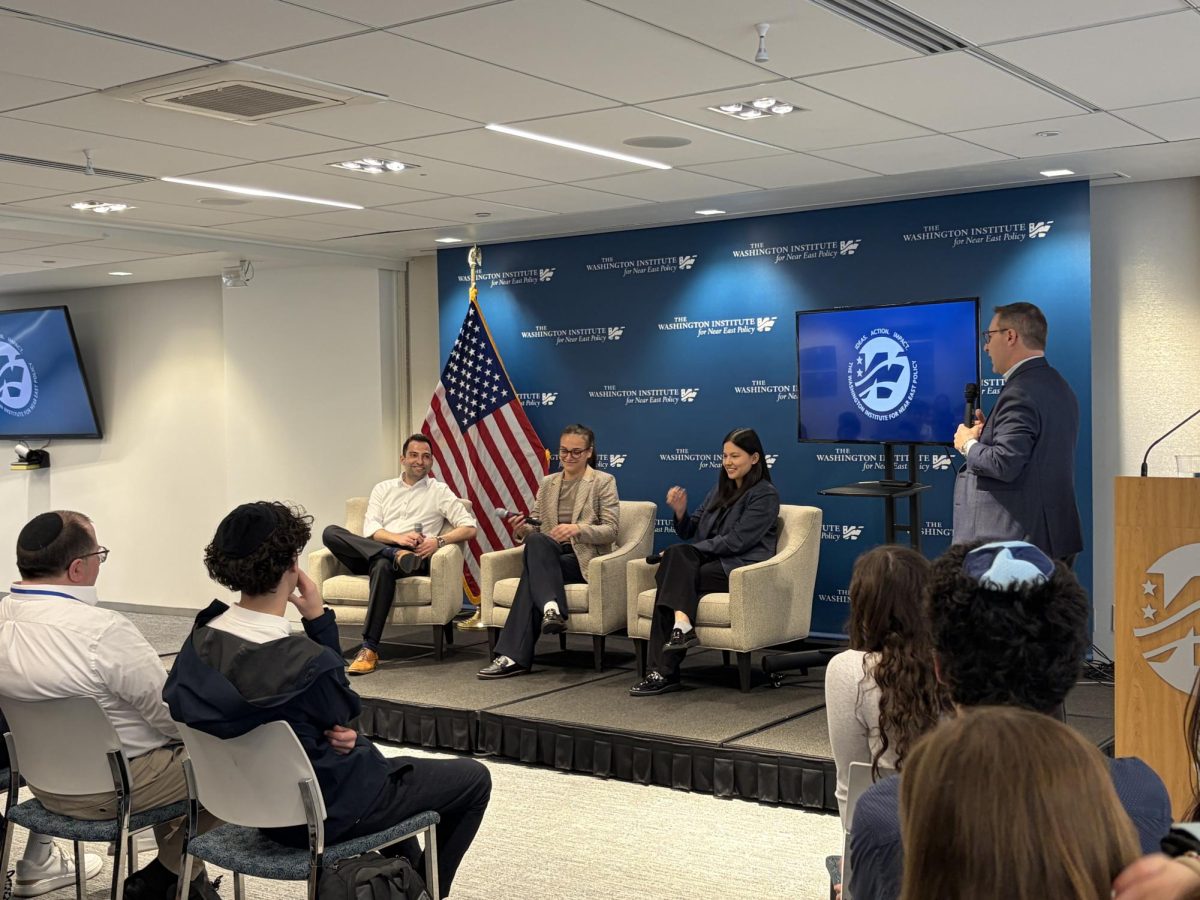
On March 25, the class of 2027 spent the day at the Washington Institute, attending five seminars led by professionals in different fields related to the Middle East. The trip emphasized current events and explained the complex context and history behind them, rather than focusing solely on the Israeli perspective. Most sessions were not directly related to Israel, but rather understanding factors in the Middle East, such as Iran, Hezbollah and other terrorism in the region.
To kick off the day, Michael Eisenstadt, the Washington Institute’s Military and Security Studies Program Director, led a session about the current Iran war. Eisenstadt specializes in Iran, Iraq, Israel and the Gulf States, and he offered a broader military perspective on the conflict.
“Students were able to come out of the trip with a broader understanding of how to analyze what’s going on in the Middle East,” Jewish History teacher Anna Band said. “We’ll talk about Middle Eastern politics, and that will enable students to look at Israel in a more informed perspective.”
JDS has brought each junior class to the Washington Institute for the past 15 years to engage with experts in their field. Visiting the institute is an opportunity often closed to teenagers, as they rarely work with schools.
Another seminar was taught by Noam Raydan, a senior fellow at the Washington Institute, who spoke to the grade about mapping maritime attacks, focusing on shipping routes in the Strait of Hormuz. Raydan is an expert in energy and economics in the Gulf States.
“Most speakers focused on the political significance of the war, but I especially liked listening to Noam, because she talked about the environmental impact it has,” junior Liana Lesser said.
Lesser is also taking the Arab-Israeli Conflict course, and she thought the trip was very helpful to expand on what she has learned in class.
The Arab-Israeli Conflict course starts in 1948 and ends with current events. As the course has not yet covered current events, the trip emphasized what is actively happening in the Middle East, provided background on why it is happening and highlighted the standpoints certain countries take.
“[The trip] gave a lot of background for what we’re learning, and just a lot of interesting information that we might not have necessarily gotten from the class itself,” Anker said. “But it’s important to know when you’re learning about it, for context.”
The final project for the class is called “Prescriptions for Peace,” in which students will write a policy paper addressing one aspect of the conflict. According to Band, some classes have already begun considering which topics they are interested in exploring for this project. The presentations by experts during the field trip furthered student engagement in how to approach current events and foreign policy in the region more broadly.
The Arab-Israeli Conflict course at JDS is an optional Jewish history class; however, all juniors went to the Washington Institute to learn about the current conflict.
“It’s important for everyone, even if they aren’t taking the class,” Lesser said. “It’s a valuable trip because it allows us to meet with leaders in their fields who know a lot about the historical significance of the political conflict and the International effect it has.”