
Freshman Adam Nesher started high school with a brand-new backpack, only to watch it quickly become dirty from constant contact with classroom floors. In JDS classrooms, students often place their bags by their feet, which makes it difficult to access school supplies and maintain backpack cleanliness. Nesher identified this problem and came up with an idea for a creation to solve it: a backpack holder.
Nesher began the innovation process around the start of the school year by measuring school tables and researching potential holder options. He produced six prototypes, fixing various design challenges, such as falling off or breaking from the weight of a backpack, in each one. Nesher said prototyping was the most challenging part of the project because each print presented new flaws in the design.
“I set out to create a design for my 3D printer that would be mass producible and possibly even help others,” Nesher said. “There are a solid amount of unique aspects of my holder that I have not seen replicated in other 3D printed holders.”
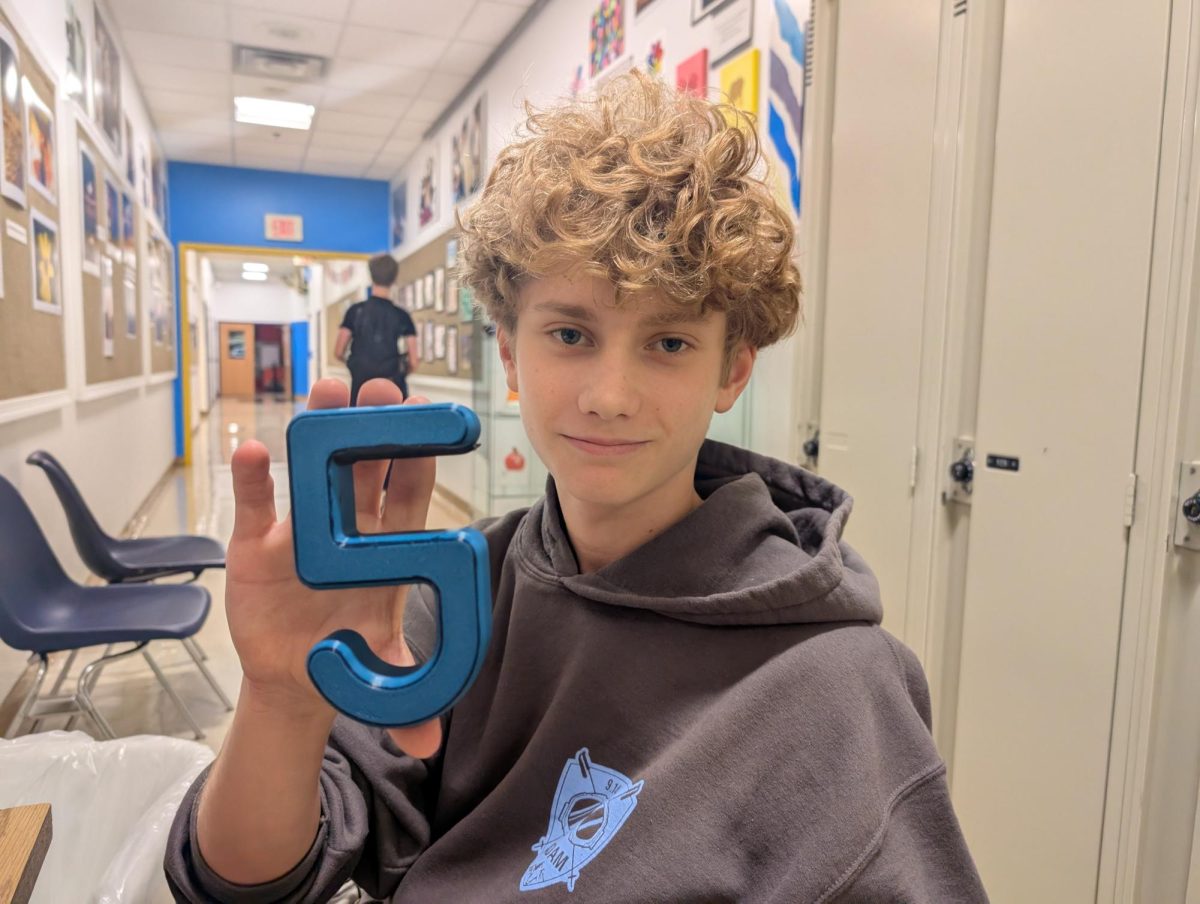
Nesher created an original design for the backpack holders that are shaped like the number five. The holders attach onto tables and are specifically designed to fit the dimensions of the JDS desks. Nesher incorporated a foam pad in the design that helps the holder stay in place on smaller-sized tables, combating an obstacle he faced while prototyping.
The impressed reactions of peers made Nesher realize he could make a business out of his innovation. Now, he charges $4 per backpack holder. So far, he has had three customers including freshman AJ Salz, as well as other students and teachers interested in the product. Salz explained that the holder helps keep his backpack clean and saves him time as it makes it easier to access his class materials.
“Some people are amazed by it, and they say, ‘where’d you get that? I kind of want that,’” Salz said. “I think it definitely saves time in the sense that it’s easier to access things.”
The plastic filament costs Nesher about $1.50 per product, and the foam sticker is around $0.10. He uses Fusion 360, a 3D printing software he learned how to use over the summer, to design the prototypes. He produces the holders on a printer at home, and they can be printed in either blue or black.
“He’s innovated his own design,” STEM teacher Terrilyn Platt said. “I do occasionally have students who come in and they want to download something off the internet, print it here, and then sell it to people. That’s kind of a no-no.”
Platt teaches five 3D printing courses in middle and high school, and said JDS has four Prusa printers and 12 JellyBOX printers. JDS students interested in 3D printing can participate in an elective, visit the makerspace or set up an educational Tinkercad account. Tinkercard is a free web app for 3D design.
Nesher has been 3D printing since he was in seventh grade, and is especially interested in mechanical and technical aspects of the process. Nesher has taken 3D Printing I, 3D Printing II – Design and 3D Printing II – Mechanics. His favorite past projects include snap clip joints, a retractable sword and snakes. For peers with an innovative idea for a 3D printing project, Nesher recommends learning how to use a software program and requesting the advice of teachers.
“One thing I learned from this experience is that even if things don’t seem to be going your way, if you persist and keep at what you want to succeed in, eventually you will see progress and possibly succeed,” Nesher said.