An Elusive Peace
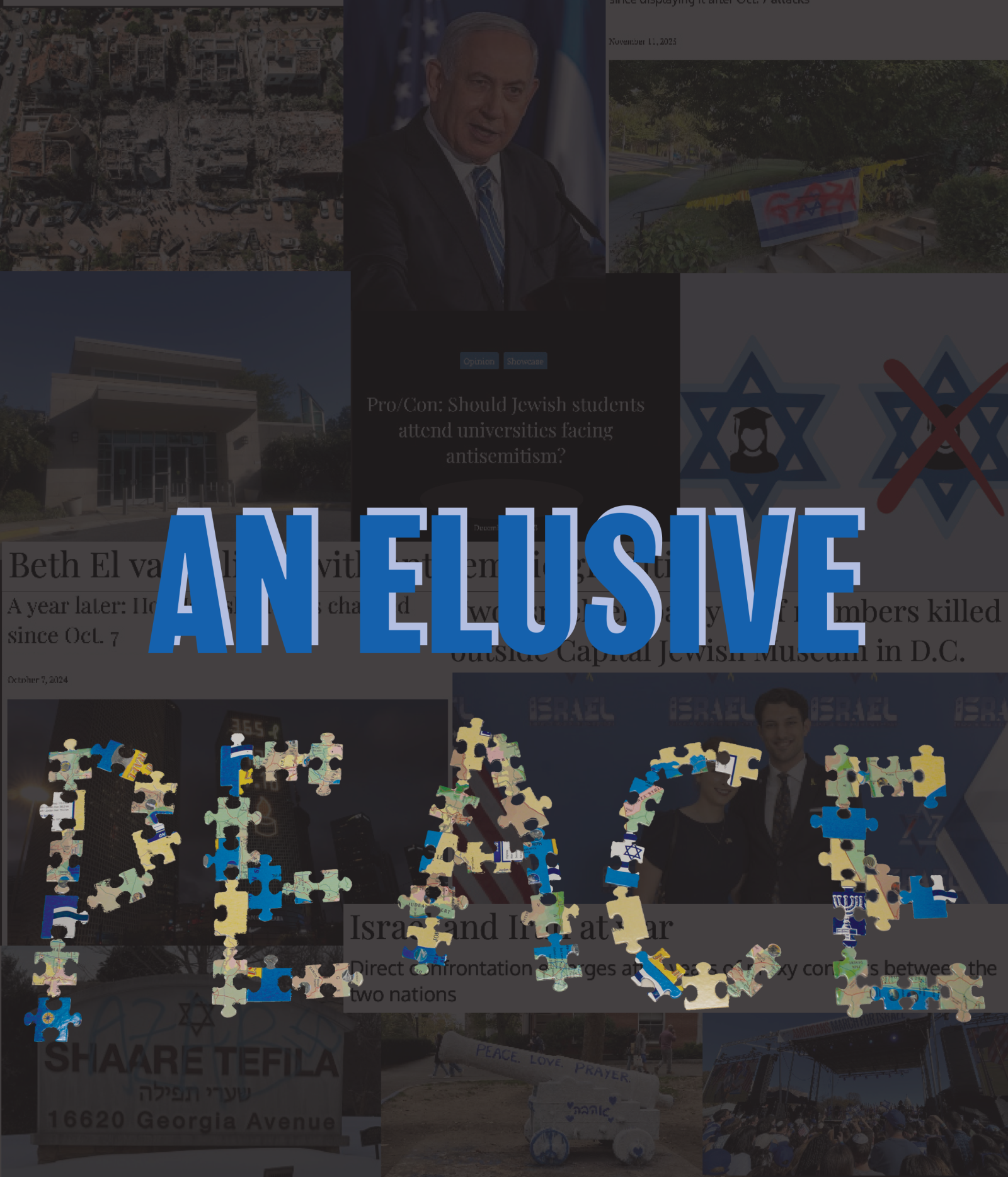
For over two years, the Israel-Hamas war reshaped daily life for Jewish and Muslim communities across the DMV, spreading fear, grief and uncertainty across the area. The Oct. 7 Hamas attack on Israel and the ensuing conflict triggered a surge in antisemitic and Islamophobic incidents nationwide. The Anti-Defamation League recorded over 10,000 antisemitic incidents in the year following Oct. 7, and the Guardian recorded over 3,500 reports of Islamophobia in the last three months of 2023.
With escalating tensions in the Middle East and the recent war in Iran, uncertainty continues to shape how communities understand the road ahead to peace. The recent ceasefire instated on Oct. 10, 2025 did not erase the difficult experiences that the war created, but it did mark a turning point. With the immediate Israeli-Palestinian crisis no longer dominating Jewish lives, and the war in Iran beginning to build, Jewish institutions across the Greater Washington area have begun asking a new question: what comes next?
Since the ceasefire, Jewish organizations across the Greater Washington area have shifted from emergency response toward attempts at rebuilding a sense of normalcy and strengthening community connection.
For the over 25,000 Israeli residents in the Greater Washington area, according to the Times of Israel, the ceasefire also marked a transition from constant fear to cautious regaining of hope for the Middle East. Senior and Israeli Ori Ben-Nun said receiving daily news of casualties during the height of the war was emotionally taxing for him.
“When it was at its peak, every day you’d wake up and see the name of another soldier who died,” Ben-Nun said. “Now, people are trying to rebuild, support one another and move forward.”
In Montgomery County, incidents of religious hatred have continued despite the recent ceasefire. On Jan. 16, Islamophobic graffiti was discovered on the exterior wall of Walt Whitman High School in Bethesda, including messages threatening Muslim and Palestinian students, according to a report from the Montgomery County Police Department.
Less than a month later, antisemetic graffiti was spray-painted on signs outside Shaare Tefila Congregation in Olney, Maryland. The banners and sign outside the synagogue were defaced with images of a swastika, the acronym AZAB, “All Zionists are Bastards,” and the word “genocide.”
“This was inevitable,” Head Rabbi of Shaare Tefila Jonah Layman said. “Antisemitic acts are on the rise in this country and around the world, and having these signs on the edge of the property is clearly visible to everybody who drives by. Georgia Avenue being a main road, [It’s] just inevitable.”
Prior to the ceasefire, college campuses across the region became targets for hate crimes, especially in the weeks following the Oct. 7 attack. Data released in February 2026 by the American Jewish Committee and Hillel International shows that antisemitism has fundamentally changed how Jewish families approach higher education. Since the war broke out, eight in 10 parents of Jewish high school students say that reports of campus antisemitism are a somewhat or very important factor in deciding where their child will attend college.
At George Washington University, protests dominated daily life directly following Oct. 7. Professor Ned Lazarus, who teaches courses on Israeli-Palestinian conflict and peacebuilding, said the atmosphere was unlike anything he had seen before.
“You take something that’s already sensitive and amplify it a thousand times,” Lazarus said. “That first year after Oct. 7 was definitely very different on our campus than any other year that I’ve experienced.”
Lazarus said that the months following the ceasefire brought a noticeable shift on campus, marked by a calmer atmosphere and fewer protests.
“It’s returned more to its natural proportions,” Lazarus said. “It’s a controversial issue that students can be involved in if they want to, but it’s no longer something where everyone feels forced to take a side.”
In addition to less conflict and fewer protests on college campuses post-ceasefire, peace of mind for Jews and Israelis in the Greater Washington area and around the world has increased, which, while abruptly disturbed by the Iranian air attacks, did create lessened fear nearby.
Since the war, the conflict has affected how conversations take place in the classroom. At JDS, the Jewish history curriculum has adapted to reflect the shifting political climate. The goal is not only to teach historical context, but also to help students engage thoughtfully with information reflecting perspectives from both sides of the conflict.
JDS has two classes that explore the Israeli-Palestinian conflict: History of Modern Israel, a required course for juniors, and Arab-Israeli Conflict, an elective. However, 74% of juniors opted into the latter this school year. While JDS is a Jewish school rooted in Zionist ideals, the Jewish history department tries to speak about the conflict with a “mature Zionist” approach, according to History of Modern Israel and Arab-Israeli Conflict teacher Jeremy Shine.
“We want them to have that [learning] experience within the safety of JDS and within the safety of the classroom, and enable them to talk about it, reflect on it, see how that impacts their own Zionism,” Shine said. “How do they reconcile some of the things that they’re learning about in terms of their connection to Israel?”
The goal of the “mature Zionist” approach is to encourage and foster a connection to Israel while making room for multiple narratives. Engaging in difficult topics that address the complexities and nuances of the situation in the Middle East is a key component of the learning that takes place in these classes.
In Shine’s class, he presents information from both Israeli and Palestinian narratives as historical moments, such as Israel’s War of Independence and the Deir Yassin massacre. Shine acknowledges that in order to have a lasting relationship with someone or something, Israel in this case, it is important to recognize that the thing is not perfect. Having a relationship with Israel and a sense of “mature Zionism” means having a true understanding of the conflict’s entire history, positives and negatives alike.
This approach is appreciated by and reflected in the lives of students in the class. When junior Brielle Bassin was in an uncomfortable situation where someone referred to the conflict as a “genocide,” she said what she had learned in Arab-Israeli Conflict so far gave her the tools to approach the conversation in a mature way.
“I think our school does a really good job at discussing that specific type of subject in school, because we learn not only just one side, but we learn all sides, and we have discussions where we stop and listen to people who might disagree with us, and understand their perspective,” Bassin said.
Junior Noah Sacks also appreciates the knowledge and perspective that his classes at JDS have given him. Not only has he learned a lot from the Jewish history curriculum, but he also feels comfortable in the JDS environment to express his opinions.
According to Sacks, his teachers have given him the context and information he needs to fully understand the conflict and be strong in his convictions. He also believes that these classes help him become more open to differing ideas.
“I think it’s just really important overall, no matter what you necessarily believe in, to be able to acknowledge both sides and to come to a really accurate understanding,” Sacks said. “That doesn’t mean that you necessarily have to change what you believe in and what you stand for, but I think what you stand for has to be rooted in some truth.”
One of the assignments in the Arab-Israeli Conflict course’s curriculum is for students to write about their own approaches to solve the conflict. This assignment gives a space for students to develop their own ideas and opinions about both perspectives as they move out of JDS and into the world with people of more varying opinions regarding the conflict.
“I think we have a great Jewish history department that’s passionate about this,” Shine said. “One that is passionate about providing the students with multiple understandings of the conflict, and empowering the students to organically develop their own connection to Israel.”
The curriculum is not only beneficial to students in high school, but as they continue on to college and the rest of their lives, according to Catalina Werbin (‘25). Werbin, who is a freshman at the University of Maryland, said that she experiences difficult discussions in her classes every day.
Werbin is a public policy major, so a lot of her learning consists of looking into national and global conflicts. On multiple occasions she has experienced antisemitism or anti-Zionism, and has had many opportunities to engage with people who have different perspectives about the conflict.
“I think coming into college and having different interactions with people is definitely scary at first, but I feel like JDS really gave me a really good foundation for how to address these conversations,” Werbin said.
Werbin’s limited experience of life outside the Jewish bubble was a serious worry for her going into college. However, the main thing that has helped her branch out has been her previous knowledge from the JDS curriculum about all sides of the conflict.
In one instance, she was even able to convince a fellow student to take an offensive sticker off their computer, something which felt like a big win for Werbin.
“I feel like because I was able to get such a good foundational education at JDS, I’ve been able to participate in really productive conversations,” Werbin said.

On Feb. 28, the United States and Israel launched a coordinated military campaign involving strikes against Iran’s nuclear infrastructure, ballistic missile sites and senior leadership. This included the death of Iran’s Supreme leader Ayatollah Ali Khamenei, according to the New York Times.
Iran is responding to the U.S.-Israeli operation with missile and drone attacks targeting Israel, regional U.S. bases and Gulf nations, according to ABC News. Members of the community, such as junior Emunah Simkovich, who have family and friends in Israel are hopeful that these attacks on Israel cease, but are also optimistic about the potential demolition of the current Iranian regime.
“I hope everyone in Israel will be okay, I’m praying for my friends and family,” Simkovich said.
Despite tensions surrounding the conflict within the Greater Washington area and the current geo-political situation in the Middle East, various groups and individuals are very open to creating peace, and hopeful for the future of both Israel and Palestine.
In order to build this future in which both sides of the conflict gain, and harm in the Middle East is reduced, everyday citizens must learn how to discuss difficult topics, such as the war, in an open minded and respectful way, according to Lazarus.
Lazarus believes that in order to have productive conversations about the conflict, one must approach the discussion without the need to win the argument, but rather to understand the opposite perspective and how it came to be.
“If you’re in a conversation where you recognize that people have different opinions, say it’s legitimate to have different opinions,” Lazarus said. “I have mine, but I don’t think that I am 100% right, and I am willing to listen to what you think and also maybe why you think about it.”
One group that focuses on creating positive and respectful dialogues between Jews and Muslims is the Sisterhood of Salaam Shalom (SOSS). SSOS is an organization in 32 states that aims to build a world in which Jews and Muslims can find common beliefs and learn how to productively advocate for ending hatred throughout the world.
SSOS’ regional programs allow women who want to build a community and whose goal is to create peace and collaborate with others hold open discussions. They also hold a youth program, in which Jewish and Muslim teenagers can become involved in the group’s mission.
One of the organization’s goals is to reduce religious polarization between Jews and Muslims. Avery Fragle, a sophomore at Georgetown Day School (GDS) in D.C. notes that at GDS, conversations about the conflict tend to be very ideologically divided, making it hard to productively discuss the issue without critique. Despite her frustration about not being able to easily express her opinions regarding the conflict, she still hopes that the future will be better for both Israel and Palestine.
“Politically, my hope is that … we can draw a border that both sides can be happy with, which is sort of like a utopian view in the situation, but that’s the ideal,” Fragale said.
Similar to Fragale, Lazarus hopes that in the future both Israelis and Palestinians will be protected and there will be less violence and reduced pain on both sides of the conflict.
He believes that it is important to acknowledge the hardships for both Israelis and Palestinians, and that strong opinions do not represent a majority of people’s perspectives. Polarization has formed extreme opinions regarding the conflict that have been created to escalate the truth, and create easier enemies, according to a Boston University report.
According to the article, each side tends to view themself as the victim, and the fight about which side is more victimized causes competition that ruins the ability to engage in conversation about the conflict with an open mind.
In order to stop this, people on both sides of the conflict must stop going into conversations hoping to convince the other side that they are correct, but rather build up similarities, like the hope for peace for both Israelis and Palestinians, rather than focusing on what sets people apart.
“You can’t solve this conflict perfectly,” Lazarus said “There’s no magic wand, but things don’t have to be this bad, right? They can be better, and it’s possible to take real steps that will do that.”
| Eliana is a member of the Class of 2027 and serves as a current editor-in-chief. As a freshman, she joined the paper in the 2023-24 school year and previously served as news editor. Her favorite piece she has written for The Lion’s Tale is “Opinion: MCPS should standardize Holocaust education.” Outside of journalism, she is class president and volunteers at the friendship circle. In her freetime, Eliana enjoys swimming and reading mystery novels. |