
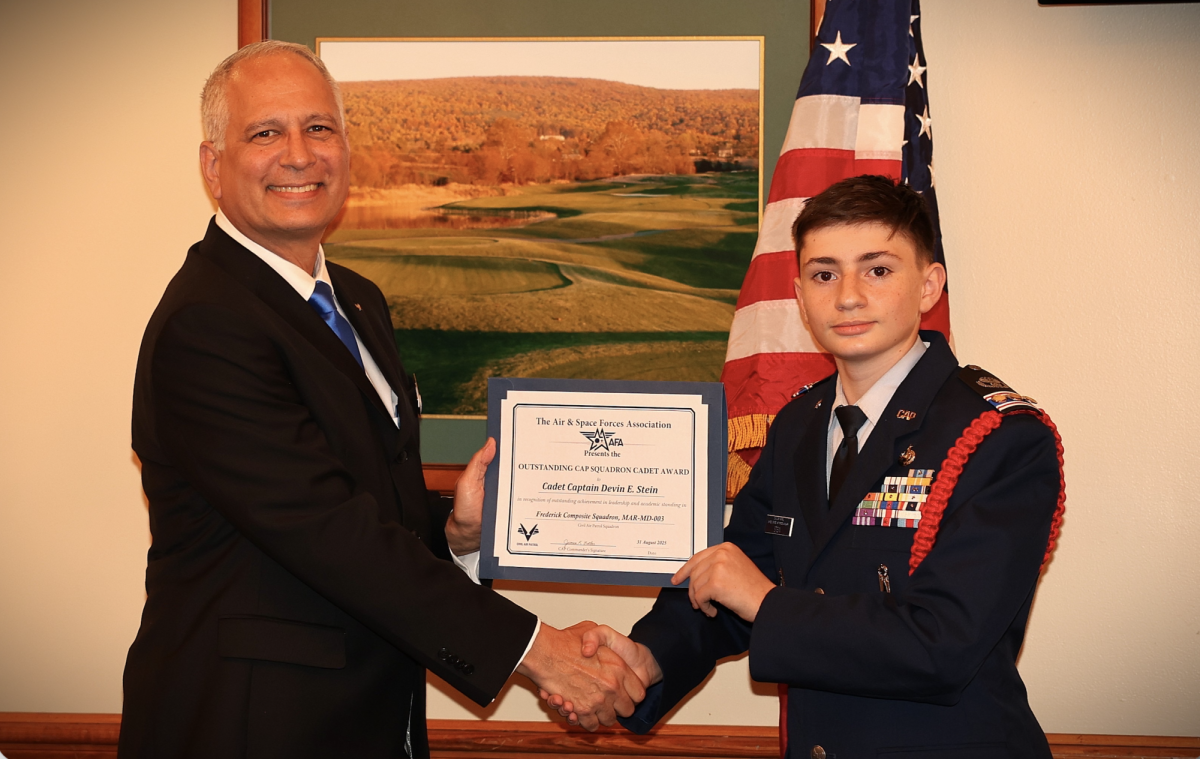
As a sixth grader, Cadet Airman Devin Stein walked up to the National Mall on Memorial Day for a march through Washington, D.C. He didn’t know what to expect. He saw 90 other cadets, all in uniform, ready to march, but he didn’t recognize any of them. He was overwhelmed and stressed at the same time.
Now a freshman, Stein went again to the National Memorial Day Parade to volunteer along with the rest of the Civil Air Patrol (CAP). Stein was broadcast live on TV as he held up a U.S. flag. Standing front and center of the column of CAP cadets, he set out marching.
The CAP is a military-style government youth program where 12 to 21-year-olds can become cadets and learn leadership and practical skills. Search and rescue is a focus of the organization. There is also a senior members program for people older than 21 to learn specialized technical skills and train cadets. The CAP is a non-profit funded by the U.S. Air Force and run by volunteers.
“Each program has different activities and things that they participate in,” Stein said. “Cadets normally participate more in leadership and character growth. Senior members focus on job-specific, specialized training, such as medical or aviation.”
Stein first learned about the CAP through his father, Avi Stein, who participated in it as a senior member. Avi now serves as a Captain in the United States Public Health Service. Stein hopes to eventually join the U.S. Air Force Academy, inspired by his father’s service in the military.
“The month after I turned 12, my dad was like, ‘Hey, you want to just see what it’s all about?’” Stein said. “He took me to a meeting, it was a lot of fun, and I just kept going after that, and I officially joined.”
After rising through the ranks by taking tests, physical exams, coming to weekly meetings and spending enough time in programs, Stein became a Cadet Major. Cadet Major is the third-highest rank Stein can achieve. When the CAP has activities like the Memorial Day Parade, Stein is responsible for 30 cadets, who look up to members with higher ranks, making it even more important for Stein to be a role model.
“You have to show up. You put your best into it. You follow the core values, which are: integrity, volunteer service, excellence and respect,” Stein said. “You need to live by those core values and be an example to all the cadets.”
Of the 1137 cadets in the Maryland wing, Stein is second-in-command of the group that manages squadron representatives. Part of Stein’s role is to listen to the cadets’ feedback and implement new solutions and programs to fix issues. He supervises the process of helping squadron representatives introduce new programs and ideas.
“It gives him a lot of responsibility, and he’s more confident than I expected,” Stein’s mother, Erica Stein, said. “I think a lot comes from CAP. It instills confidence and pride in a way that school doesn’t always do for everybody. It’s really great to see your kid get really excited and passionate about something. This is his passion, and it’s fun to watch him explore it.”
One cadet who works directly under Stein is Cadet Chief Master Sergeant Emerson Harne. He functions as a flight sergeant who guides a smaller group of cadets, but serves below squadron commanders like Stein.
Harne said that the CAP emphasises education through community-building, where members can learn life and leadership skills. This type of community is built by CAP’s hundreds of different activities. One example is Hawk Mountain Ranger School, which teaches cadets search and rescue with their squadrons.
“It’s a super fun experience. I learned a lot of search and rescue tactics: how to repel, how to tie harnesses, all sorts of search techniques,” Harne said. Other programs teach urban direction finding and how to locate people from the air and ground.
Another great example of CAP’s community building is the parade on the National Mall, which Stein attended. It enables all its members from different squadrons to interact and meet new people while participating in a fun activity.
Now, every year when Stein returns to that parade, he looks forward to it instead of being nervous. He knows everyone who was there, whom he was so intimidated by. He’s learned more than names and faces; he’s also learned search and rescue, how to supervise and how to implement feedback to better the CAP as a whole.
“Each person is a pillar that can be used to build higher, towards success,” Stein said. “Each person brings another thing to the table that can be used to go further and further. As an organization, we can use each pillar to support each other.”