
As someone who has been going to JDS since kindergarten, I have been grateful for the enrichment JDS provides to students who can use an extra challenge in Judaics classes, both in the form of advanced classes and supplementary material. For me, the height of this experience was in middle school, when I was able to learn Tanakh fully in Hebrew with other like-minded students. So when I explored my course options for high school, I was disappointed to find that such a course would not be available to me.
Tanakh is a Hebrew acronym for the books of the Hebrew Bible, which are the Torah, Neviim, and Ketuvim. JDS requires students to take Tanakh classes every year in middle school, with classes being taught in both English and Hebrew depending on a student’s level. Students in the most advanced Tanakh class read and discuss the text fully in Hebrew, an option not available to any high school students.
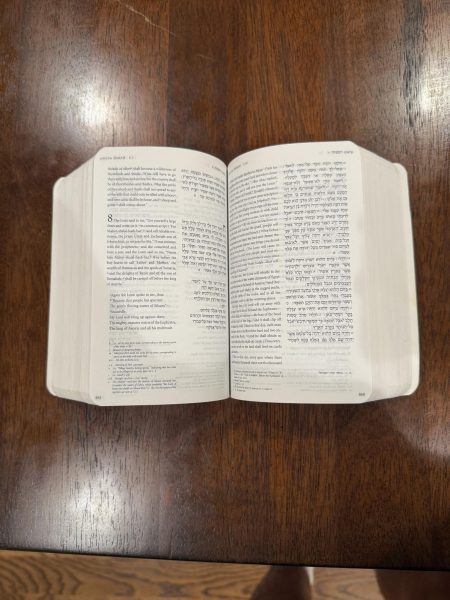
Hebrew language is one of the most significant aspects of Judaism, connecting Jewish students today with the history of the Jewish people. Learning the Tanakh, the lifeblood of Jewish religion, in Hebrew, allows students to strengthen that bond even more.
This sentiment is echoed by Head of School Rabbi Mitch Malkus. In a blog post published on JDS’ website in 2022, he wrote, “Only the Hebrew language links us to the past, present, and future of the Jewish people, and to a specific land. No other language…bonds us to the soul of our history, textual tradition, people, and the land of Israel than Hebrew does.”
Additionally, learning Tanakh in Hebrew would be beneficial for many JDS students because of the impact it would have on their Hebrew skills. In the Lower School, students spend half a day every day learning Hebrew and Judaics. This dips to only 55 minutes of Hebrew class twice out of every three days in high school.
As a result of this, students don’t gain as much Hebrew proficiency as they did in years prior, and seniors are less prepared to communicate with Israelis during their semester in Israel.
In 2025, out of 74 JDS juniors, while 50 qualified for the “functional fluency” level according to the Global Seal of Biliteracy, defined as “Intermediate-Mid,” only three out of the 74 qualified for the next level, “working fluency.” This shows that JDS students’ Hebrew ability is reaching a plateau in high school, and they aren’t able to grow as much as they did earlier at JDS.
According to Dr. Alan Mintz, a professor of Hebrew Literature at the Jewish Theological Seminary, learning Tanakh in Hebrew can simultaneously improve one’s understanding of Tanakh itself while also improving one’s mastery of the Hebrew language.
“Teaching classical texts in Modern Hebrew creates an unbeatable synergy in which more Torah knowledge and more language skills are attained than if each were taught separately,” Mintz said. “When students begin to recognize that the root stems they are manipulating in their spoken language are in many instances the same as the ones they are recognizing in the texts they are reading, then they are experiencing something very important about the nature of Jewish civilization.”
This reasoning is similar to the reason that we study Shakespeare in English class—not just for learning the content of his plays, but to advance our own knowledge about the English language and how to analyze it. This is the same with Tanakh, except that the content we can understand while reading it in Hebrew can be so much more meaningful to us as Jews.
According to Jewish Text Department Chair Grace McMillan, JDS used to have high school Tanakh classes in Hebrew, but they were removed from the curriculum due to a combination of factors, including scheduling concerns and the fact that many students who would like to take a full year of Jewish text choose to study Talmud instead of Tanakh.
JDS should add a Hebrew Tanakh course because it would provide a challenge for those looking to expand their Torah studies and Hebrew language abilities. Above all, a Hebrew Tanakh class would strengthen their connection with the Jewish language and history.