

U.S Armed Forces
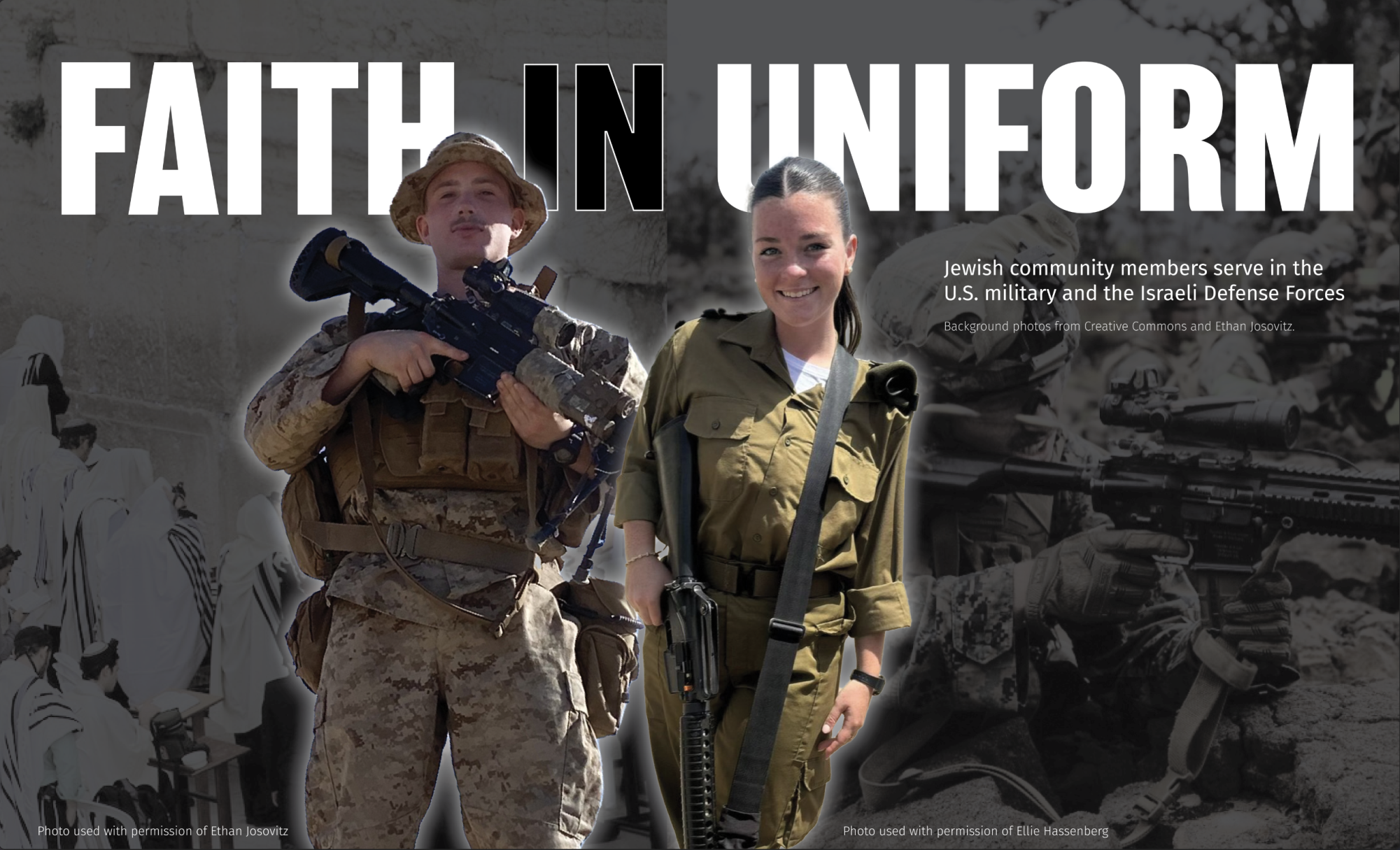
Ever since Ethan Josovitz (‘17) was young, his image of a hero was always a Marine. After growing up in a patriotic home and hearing stories of his grandfather’s army service during World War II, service to his country was a natural course of action. Josovitz enlisted in the Marine Corps as an infantryman in 2018 and served for four years, stationed in Hawaii and Japan.
“I felt indebted to the country for my life,” Josovitz said. “I’m alive because the country took my family, so I always look back on those factors as being huge decision makers and huge factors into my decision.”
Sophomore Evie May’s motivation to join the military is also family-oriented. As the daughter of an Air Force Lieutenant Colonel, she saw how her dad developed during his military service to become a more disciplined, responsible and family-oriented person. May wants a similar experience; her goal out of military service is to find meaning but also to give back to her country.
“It’s just such a privilege to be able to live in a country where we have so many rights and so many freedoms, and protecting that right is just a good way to live my life,” May said.
Ezra Caplan, U.S. Air Force Colonel and father to freshman Asher Caplan, joined the Reserve Officer Training Corps (ROTC) through university. Caplan was driven to join ROTC because of scholarship opportunities, appreciation for American history and a desire to participate in something bigger than himself.
While Caplan always wanted to serve in the U.S. military through ROTC, May has considered joining the Israeli Defense Forces (IDF). However, she is more interested in ROTC.
“It’s a different kind of service in Israel,” May said. “It’s serving the Jewish community, not just in Israel, but all over. And it’s more of a service to God…a service to your religion, different than a service to your freedoms.”
Both Caplan and Josovitz had to initiate creative ways to observe Judaism in the military, as Jewish accommodations, such as kosher food, are not readily available.
“Being Jewish is different than when mainstream America lives in other places,” Caplan said. “Everything from the idea that Shabbat is a little bit different to the accessibility of kosher food. When we went to Germany, they didn’t have kosher markets like they do here. So it was a lot harder to get kosher meat.”
When Josovitz was stationed in Japan, he struggled to stay religiously connected without any Jewish-related programming for the majority of his service. However, he visited an Air Force chaplain to complete Shabbat rituals such as candle-lighting and a meal. Josovitz didn’t compromise on some Jewish practices, though, and always asked his officers to take off on Yom Kippur to fast, a decision which they supported.
Despite the challenges Caplan faced to stay connected to his Jewish identity, he said that in recent years, new resources for observant Jews have developed and expanded to help more Jews.
“Over the last 20 years, the community has worked really hard to get more Jewish chaplains,” Caplan said. “Before that, it was a lot harder and a lot more individual and on my own.”
Caplan encourages any Jew, regardless of their observance level, to join the military. He believes that serving in the military is a great opportunity, and that there are many more Jewish people in the military than it seems who are building a strong Jewish community. He sees many similarities between Jewish and American ideals, which he aims to emulate in his service.
Josovitz also encourages all who are interested to join the U.S. military. His main reflection on his service was that it gave him a new appreciation for what it means to be an American.
“[After serving], I felt stronger about patriotism and being an American, because I finally did something I never thought I’d actually do,” he said. “And I actually did it. I served the country, and the country values me and takes care of me.”

Israel Defense Forces
For some Americans, serving in the army isn’t limited to the U.S. military. Daniel Greenblum (‘09) served as a paratrooper in the IDF starting in 2011, and was heavily influenced by his Zionist upbringing and past Israel experiences like the JDS Israel trip.
“For me it was always about Israel,” Greenblum said. “I hadn’t really considered anything else. I think that was sort of my calling.”
Senior Tani Simkovich also hopes to serve in the IDF. Like Greenblum, he only ever considered serving in the Israeli military as he feels strongly about protecting the Jewish homeland.
“It really just stuck out to me, the fact that Hashem told us that we were given this land,” Simkovich said. “Having a homeland for all the Jewish people is a privilege, and I feel like I should have to serve and protect the land that Hashem gives [us] this opportunity to have.”
Another contributing factor for Americans who want to enlist in the IDF is a greater sense of urgency during war. According to The Times of Israel, there was about a 30% increase in lone soldiers (soldiers from abroad) through Garin Tzabar, an organization that helps many immigrate to Israel and enlist in to the IDF.
The war drove Ellie Hasenberg (‘22) to enlist in the IDF. After visiting Israel on a Birthright trip in 2024, Hasenberg acted on her lifelong dream of living in Israel. What began as a temporary stay to volunteer with the Israeli organization Save A Child’s Heart, led to Hasenberg enlisting in the IDF as front-line medic, halting her pre-medicine studies at the College of Charleston.
“I don’t think I’d be where I am now if the war hadn’t started,” Hasenberg said. “I was in Charleston, and there aren’t a ton of Jews there … It was hard for me not having any Jewish friends there that really understood what I was going through and what this country was going through, more importantly.”
Hasenberg and Simkovich both value the Jewish community when it comes to military service. Especially for Hasenberg, who felt isolated as a Jew at the College of Charleston, the IDF community fostered a greater sense of belonging and understanding.
“Once I got here, it was just something inside of me that was like, ‘I need to do this,’ and not even for myself, but for this country that I believe in, that so many people don’t really understand,” Hasenberg said.
Despite the sense of community that Hasenberg feels fighting for and among the Jewish people in Israel, she finds the distance as a lone soldier to be a challenge and tries to stay as connected as possible with family and friends back home.
Greenblum identified this same challenge, especially when it came to staying in touch with family. However, something that made this challenge more bearable for him and others was the vast and strong lone soldier community in the IDF.
“I was far from the only lone soldier in my unit,” Greenblum said. “There were many from all around the world. There were British, there were South African, Russian, Ukrainian and Ethiopian, and there was really the community of the people that you serve with, and then the sub-community of other lone soldiers and other Americans.”
Simkovich is still unsure whether he will follow in the footsteps of many other JDS alumni and join the IDF. However, he believes that those who choose to enlist in the IDF should do so with deep passion and intention.
“It is a big commitment to join the IDF, and it’s not something that you should do half-heartedly,” Simkovich said. “It’s something that you should want to put all your attention into and it should be a really meaningful experience for you. Once I feel like I could reach that goal and I can have it be a meaningful experience, and I feel that connection to Eretz Israel, that’s when I feel like I should join the IDF.”