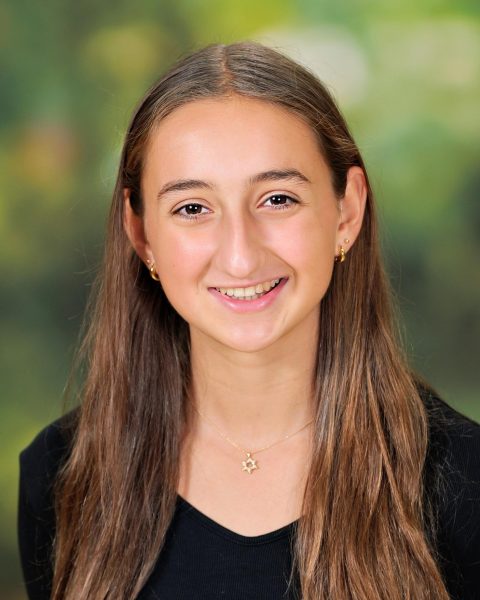



As senior Ella Arking sits at the Shabbat dinner table surrounded by her parents, siblings and cousins, her family engages in political discussions with members taking stances from all sides of the political spectrum. Arking herself has not always aligned with any single side; her perspectives have shifted in response to global events, especially recent issues around the topic of Israel.
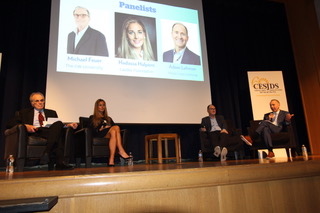
According to Michael Koplow, Chief Policy Officer at the Israel Policy Forum and JDS parent, skepticism toward U.S. support for Israel has grown across the political spectrum since Oct. 7. On the left—particularly among the far-left of the Democratic Party—rising sympathy for Palestinians reflects concerns about Israel’s democratic values and conduct in Gaza. On the right, America First figures including Tucker Carlson, Candace Owens and Joe Rogan argue that U.S. aid to Israel offers little benefit and should be redirected at home.
“On both the right and the left, I think the Gaza war and Oct. 7 have really increased this idea that used to be on the far edges, but…is encroaching more and more towards the middle, this idea that Israel is not a country the U.S. should support,” Koplow said.
For Arking, growing criticism of Israel was most prominent in the more left-leaning community. While Arking identified more strongly with the left through her early teenage years, she began to question her views after the Israel-Hamas War began.
“Seeing the reaction of the left side to everything that was happening in Israel, seeing how [far leftists] supported Hamas and everything like that, made me start to question the stuff that I believed, and I started to question the ideologies of the left wing and actually look into what my beliefs are based on,” Arking said.
Arking began to see the left as categorizing narratives into the “oppressor versus the oppressed.” She realized the narrative that the left used to categorize Israel didn’t just apply to the Israel-Hamas War, but defined the views of the movement altogether.
“I didn’t like [the oppressor versus oppressed narrative] with the Israeli conflict, and I also just didn’t like it in my personal life,” Arking said. “I didn’t want to feel like a victim to everything around me. I wanted to celebrate who I am and being an American.”
For senior Simon Bard, Israel wasn’t a political topic that was on his radar until Oct. 7. Rather, he dismissed all criticism of Israel as antisemitism. However, Oct. 7 and the war that followed pushed this view and encouraged him to explore the nuance in the conflict.
“I started seeing stuff about Israel more in the news and I realized that it’s a very complicated issue and there’s some validity to critiques of Israel,” Bard said. “Not every critique of Israel is straight antisemitism. But for me, it introduced me to the topic and let me do more research.”
Bard doesn’t believe the topic of Israel should play a large role when thinking about American politics. Despite this, Bard noted that, especially during the most recent presidential election, he observed many Jews who don’t agree with President Donald Trump’s domestic policies voted for Trump regardless, due to Trump’s approach to Israel.
According to the Hartman Institute, there is a wave of Jews who have decided that they are single-issue voters in regards to Israel, and for that reason, voted for Trump. Similarly, Arking has noticed a greater movement right within politically conservative Jews.
“I do think that I’ve seen the people who aligned with the right before, I think, are pushed even further to the right because of the conflict, because it reaffirms and fuels their belief that the left wing is a little bit crazy and it just fuels their support for the right,” Arking said.
Koplow notes that while most American Jews still identify as Zionists, many liberal Jews are struggling with Israel’s actions in Gaza. There are rising concerns that the high Palestinian death toll and IDF military actions conflict with their Jewish values.
At a global level, the 2025 Jewish Landscape Report surveying 10,000 Jews found that 49% identified polarization and dialogue between Jewish communities as a critical internal challenge, the second biggest challenge after rising antisemitism. This embrace of many opinions, according to Arking, is what makes the Jewish community so unique.
“I think that polarization is inevitable,” Arking said. “I do think, though, that it’s kind of special that in a Jewish community we also have stuff that we can really agree on. I think that being Jews, we’re able to find a commonality, and we’re able to agree on some things. But even within those things, there are disagreements.”