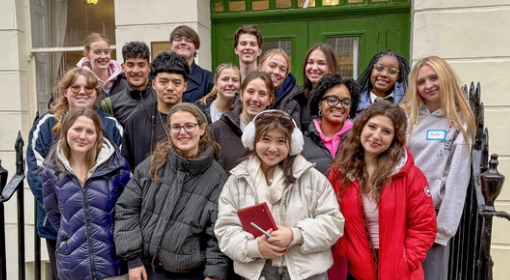


Without any electronics or technology, freshman Jack Spiegel and sophomore Emmanuel Sarantos adjusted their rocket according to the weather and prepared it for launch. As their rocket blasted towards the sky, they watched as it reached the altitude required and scored second place in The American Rocketry Challenge (TARC). This year, the JDS team has been selected for the NASA Student Launch Challenge for their rocket named Sky Broom. In the challenge, teams from across the U.S. design and launch rockets at NASA’s Marshall Space Flight Center in Alabama.
The JDS Rocketry Team, composed of both middle and high school students, entered a submission in TARC for the last five years. However, this was the first year they were in the top 100 submissions that continue on to finals. TARC is an annual model rocket competition sponsored by the Aerospace Industries Association and the National Association of Rocketry with the goal of “foster[ing] leadership, teamwork and problem-solving skills,” according to the competition’s website.
The team is led by club adviser and Director of Instructional Technology Ginger Thornton, and mentored by Northern Virginia Association of Rocketry member Jonathan Raine.
“I was really more of a robotics person when I started doing this,” Thornton said. “I think for me, personally, part of it is that I find space immensely interesting. So, the idea of doing in miniature what NASA does in large part is cool.”
There are multiple steps to building a competition-ready rocket, according to Thornton. First, it is designed and built virtually on software called OpenRocket, and flights are simulated until the rocket flies the way that it’s intended to. Then, the rocket is made according to the software’s model using cardboard tubes, plastic, wood, metal casing and a motor. The rocket also must carry an altimeter which records flight data and a raw egg that is not allowed to crack over the course of the flight.
While the club is composed of both middle and high school students, they entered last year’s TARC as separate teams. The middle school team advanced to the final round, which overlapped with the eighth-grade capstone trip to Atlanta on May 17. Spiegel opted to fly back to Maryland early in order to participate, and Sarantos was permitted to accompany Spiegel despite being a high school student.
“I think it’s a good opportunity to … be able to actually build something, to show your knowledge, test your abilities and also to make friends and engage with the wider communities who also do similar things from other schools,” Spiegel said.
The team was ultimately successful, despite the challenges they faced along the way. For example, the area around JDS is restricted airspace due to its proximity to D.C., requiring the team to drive an hour away to Walkersville, Md. to complete test flights. Additionally, Spiegel and Sarantos could not adjust the rocket to the weather and wind conditions on the day of the competition, due to the event taking place on Shabbat.
“It was an exercise in a lot of planning,” Sarantos said. “Most teams were not going in there praying [like JDS was].
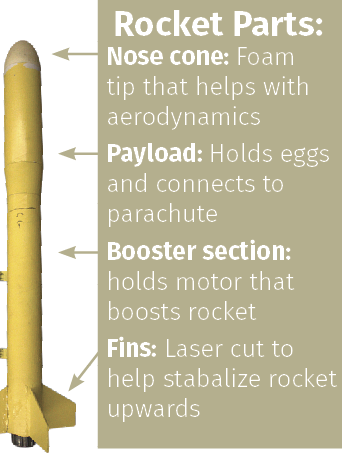
We couldn’t launch our own rocket because that requires a spark, so we had to have a different team do that. Other teams had electric levels, which could tell you accurately to the degree, and we were using a bubble level.”
The team is currently working on their projects leading up to this year’s TARC and NASA competitions, including new custom metal casing. Everything has to be tested and tweaked, making it a long and intricate process prior to launch day.
“Everything matters [in rocketry],” Thornton said. “A little slight change in weight here or there, or where the weight sits in the rocket changes everything. It changes how high it flies … It’s very precise, and I think I enjoy that, and it’s just fun to watch kids do something that, for me, is really unique and unusual.”