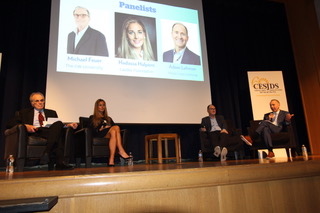

To commemorate the massacre of Oct. 7, Israeli author and journalist Lee Yaron spoke to the high school on Oct. 9 about her award-winning book, “10/7: 100 Human Stories.” During the assembly, she was interviewed by senior Sophie Schwartz about the meaning and process behind writing the book.
Two years ago, on Oct. 7, 2023, Hamas terrorists stormed towns and kibbutzim, killing over 1,200 civilians, soldiers and children, and taking 251innocent people hostage. Since then, an Israel-Hamas war has affected Israelis and Palestinians on both sides.
A deal was brokered between Israeli and Hamas leaders by President Trump on Thursday, Oct. 8, guaranteeing a ceasefire in Gaza and an immediate return of all living and dead hostages that Hamas can secure, according to CNN.
Before Oct. 7, Yaron was participating in a fellowship in the U.S. to learn about climate journalism at Columbia University. When the Israel-Hamas war started, she wanted to do anything she could to help the effort, which, in her case, was writing.
Working as a journalist for Ha’aretz, Yaron felt like she didn’t have an opportunity to share the stories of bravery and loss on Oct. 7, so she decided to compile as many stories as she could into a book. “10/7: 100 Human Stories” won the 2024 National Jewish Book Award, the 2025 Natan Notable Books award and has been published in seven different languages.
“I wanted us to learn about these people for who they were, for their lives,” Yaron said. “And in order to do that, [we] need to dive deep and stick with their families and actually get to know them and their communities.”
When writing her book, Yaron says she focused on three main principles. The first is diversity, highlighting different kinds of communities or people. “10/7: 100 Human Stories” contains stories about holocaust survivors, Arab Israelis, peace communities on the Gaza Border and more.
Yaron said that the second principle that guided her writing was the representation of the underprivileged, families who do not have enough resources or connections to make their stories heard. The last and most important principle was to connect the stories, Yaron said.
“The backbone of the book is this web of relationships and connections between the victims, and it’s a much more accurate way to understand 10/7, not as a tragedy of individuals, but a tragedy of communities,” Yaron said.
A specific story that impacted Yaron during her work is about a nine-year-old girl who passed away a few weeks after the war started due to a stress-related heart attack caused by the constant bombing and fear.
“It really teaches us so much about the way Israeli kids are living in so much fear, and Palestinian kids as well, and there’s so many victims that we don’t hear about in the news every day, but are just suffering from fear and grief,” Yaron said.
Hebrew teacher and Israel engagement coordinator Anat Kaufman planned for this year’s assembly to focus on the lives that were lost and stories of bravery and on Oct. 7.
“We have to know as many stories as we can, because it’s not one story that happened on October 7,” Kaufman said. “…It’s so many stories, it’s difficult for us to process that, and [Yaron] processed it.”
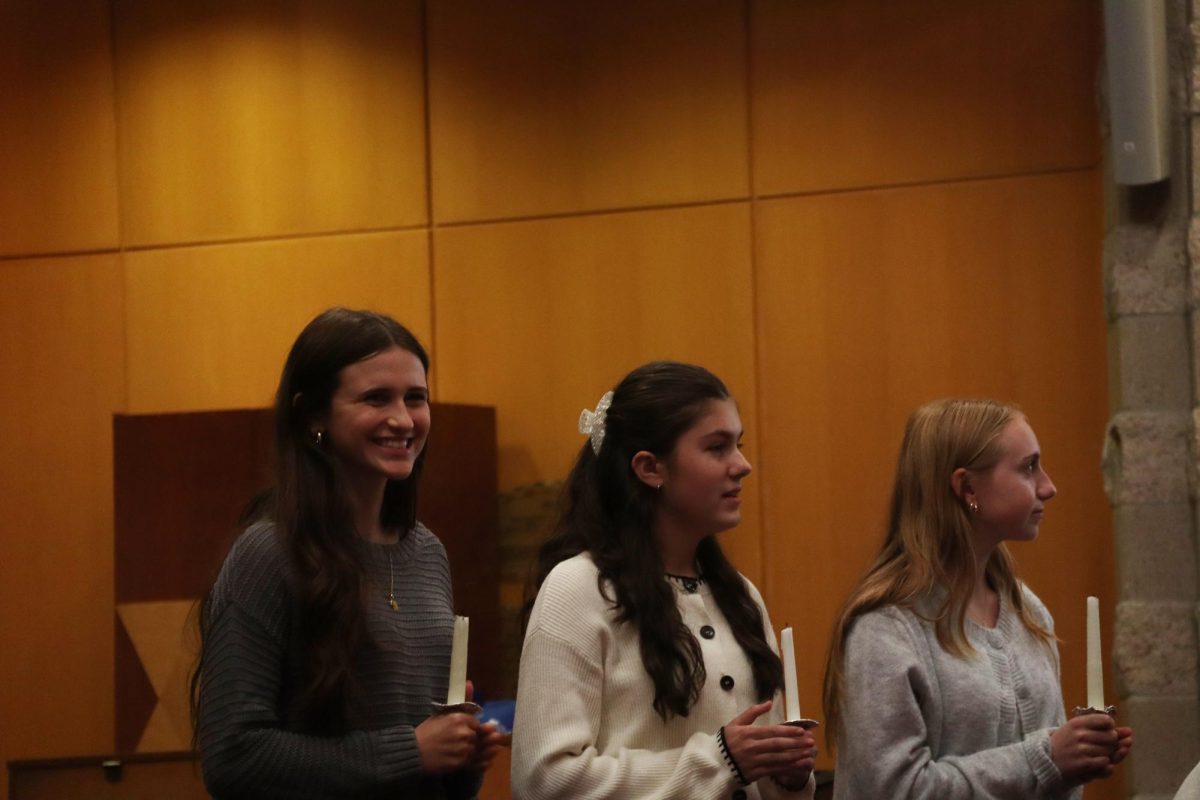
During the assembly, Head of School Rabbi Mitchel Malkus also shared his thoughts on it being two years since Oct. 7, and seniors Hadriel Dayanim and Maya Greenblum performed Hatikvah and Acheinu.
In addition to Kaufman’s planning, seniors Ian Liss and Josh Dori helped write scripts to introduce Yaron and her work.
“It’s important to have speakers, because it’s one thing to learn about things, but it’s another thing to have people, especially journalists, on the ground in Israel who can tell firsthand accounts of certain things,” Liss said.