
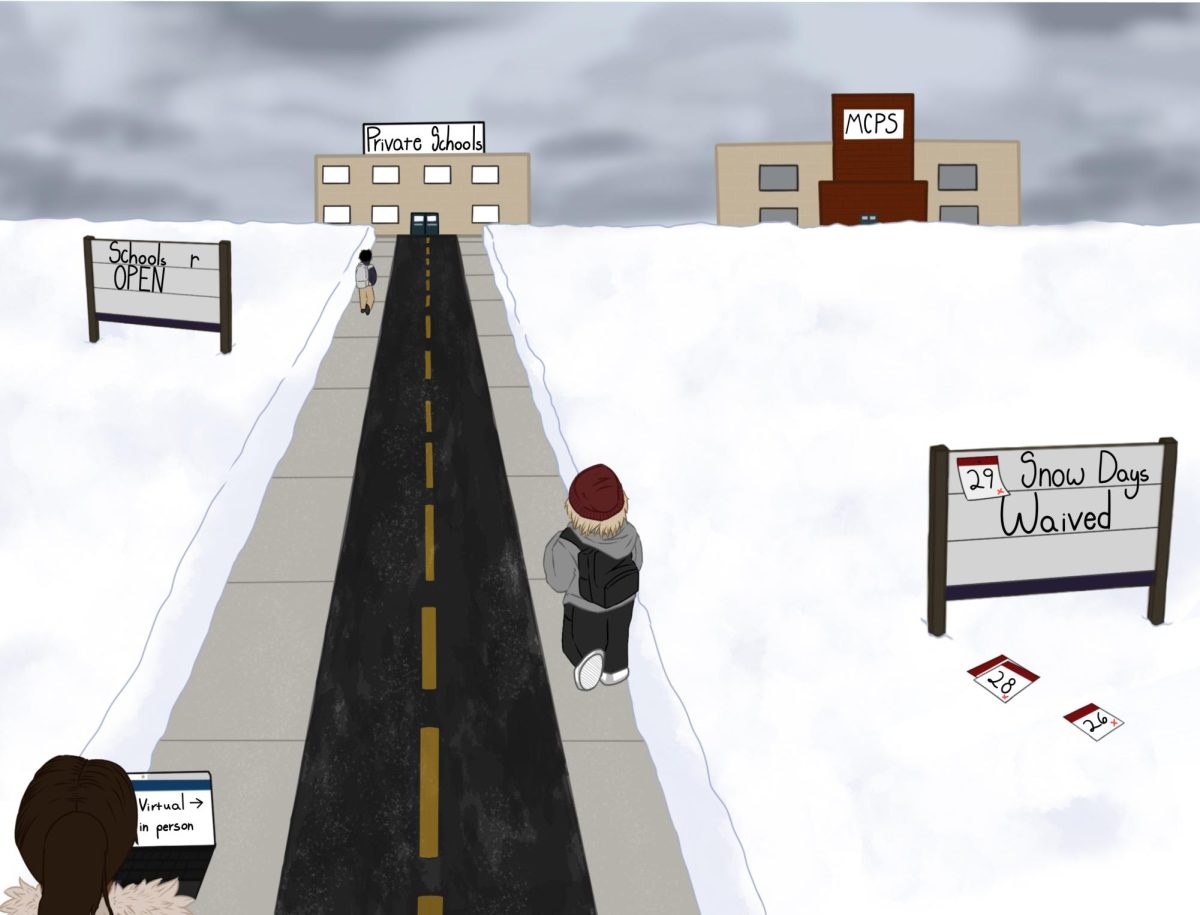
The last week of January marked the largest snowstorm to hit the Greater Washington area in years, wreaking havoc in Montgomery County. For JDS, the storm meant one day off of school followed by two virtual learning days, and then a return to in-person learning. However, for Montgomery County Public Schools (MCPS), the same storm caused six missed days of school and multiple 2-hour delays, with no virtual learning option.
This contrast highlights a serious social equity issue: students in public schools face significant barriers to continuing their education during emergencies, while private school students can rely on continuity in learning.
As high school students, we of course appreciate a snow day. But the MCPS’ slow response shows how little public education is prioritized in times of crisis. Why were shopping centers plowed before MCPS parking lots? How can schools be so disregarded in times of crisis? These decisions have real consequences for students’ education.
While we are grateful for JDS’ ability to make independent decisions following the first day of the storm, we must also recognize the weaknesses in MCPS that resulted in the loss of an entire week’s worth of learning. Typically, this number of snow days requires MCPS to add days to the end of the school year or adjust spring break to meet the 180-day school year minimum.
Historically, however, the governor has often waived at least some of these additional days. This year, the MCPS school year has been extended by four days, although two of them are early release days. While it is good that the county did not entirely dismiss the snow days, there is still learning that will have to be made up.
Beyond this specific storm, MCPS’ lack of emergency response highlights a larger problem: education during times of crisis. Thi was also the case during the COVID-19 epidemic, when MCPS schools returned to in-person learning much later than private schools.
In these situations, JDS can ensure that students continue learning virtually. MCPS students are unable to rely on this steady response as not all students have at-home devices.
The ability to maintain a consistent response for MCPS students depends largely on factors outside of the school system’s control. Snow removal is handled by the Maryland Department of Transportation, which prioritizes plowing routes based on efficiency rather than school access, often leaving neighborhoods and sidewalks impassable for days. At one point, MCPS even asked families to shovel their communities’ sidewalks so schools could reopen, an appeal that reveals just how unsustainable the system is.
JDS’ ability to quickly pivot allowed students to continue their education, demonstrating how access to resources can shape a school’s response during an emergency. However, this flexibility also reflects a position of privilege. With only two campuses to manage and a student body in which nearly every family has access to reliable technology and internet, JDS faces logistical challenges very different from those of MCPS, which serves over 200 schools and a far more economically diverse population.
This contrast reveals that the core issue is not the dedication of any single school system, but the chronic lack of resources in public education as a whole. True commitment to education is shown not just in programs or test scores, but in how the system and county protect students’ learning when it is most at risk