
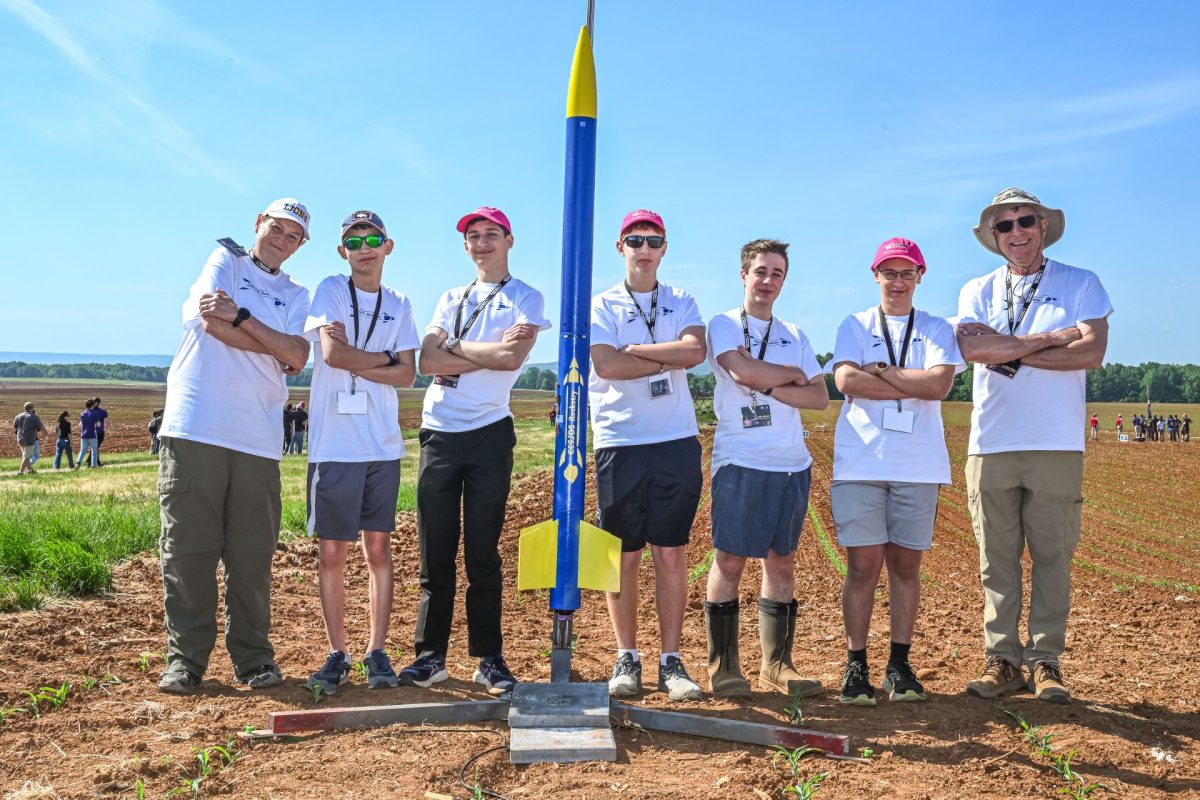
As sophomore Emmanuel Sarantos stands in an open field in Huntsville, Alabama, he hears the final countdown before JDS’ rocket is launched in the air. Although the moment lasted just about 90 seconds, Sarantos and his team had been working toward this launch since the beginning of the school year.
Following their second place finish in the American Rocketry Competition last year, the JDS rocketry team was invited to enter into the NASA Student Launch Initiative (SLI). Out of 30 teams who applied, JDS was one of 10 that got accepted. The competition took place from April 22-26 and included entries from high schools across the U.S.
To enter, the team first had to create a proposal about their vision for their rocket. Each team set their own goal height for their rocket to attain, creating a unique specialized cargo, or payload, that their rocket would feature. Once accepted to the competition, they worked with a timeline set by the organizers, serving as checkpoints during the planning and building.
“The process is very tedious for multiple weeks, getting all of your pieces put together, purchasing things, because you can’t exactly buy a rocket motor from just anywhere,” Sarantos said.
Their first milestone consisted of a 75-page report detailing a full design of their rocket, payload and data from simulating their model’s flight. A few weeks later, the team gave a virtual presentation to experts at NASA.
“We would probably get grilled for 45 minutes on all the science in our presentation, and people, a bunch of NASA scientists, asking about the finer details of what we had just written,” Sarantos said. “And that was both cool and really nerve wracking every time, because they asked questions and you can’t really answer always at the level they want you to.”
After receiving approval to move forward, the team started turning their ideas into reality and created a half-sized version of their rocket. They were then able to test fly the smaller scaled version and see how the different components of the rocket worked.
In January, the team transitioned to creating their real rocket. Using Kraft paper, 3-D printing and a laser cutter, they prepared their final rocket to test fly and deploy its payload. For the payload, they laced a parachute with petroleum jelly to take samples of air particles for when the rocket is in the air.
“I think that’s when we first kind of realized that we were having more success than a lot of folks,” Director of Instructional technology and club supervisor Ginger Thornton said. “They mentioned that … a lot of teams had not successfully been able to test and had not successfully test flown.”
However, the process was not always entirely smooth, with this year’s high number of snow days resulting in test flight days being canceled. Despite this, they arrived at the competition fully prepared and ready to launch. Sophomore Ezra Libbin, who has been on the team since he was in seventh grade, was both anxious and excited for the launch.
“I was a bit nervous about the motor going wrong, or stuff exploding, but I was mostly pretty excited because I was going to see a lot of big rockets shoot up,” Libbin said. “And there is a lot of stuff there that was much bigger than I’ve ever seen before, and also a lot of cool designs.”
The team is still awaiting evaluation for their launch and will be giving a final presentation on May 15 at Capitol Hill. There, they will explain their design process and experience in SLI.
“It’s kind of amazing seeing something that you’ve built rocket into the sky,” Sarantos said. “It was just amazing sitting there and being like, ‘Wow I’m at one of the toughest rocketry challenges in the United States. All this work has just produced something amazing.’”